

It sounds counterintuitive, doesn’t it?
You hire a facilitator (what is a facilitator?) and bring people into a meeting room, often at great expense. Workshop participants expect guidance, expertise, direction, and knowledge transfer.
So why shouldn’t the facilitator speak much? Because in a truly effective workshop, the learning belongs to the participants – not the facilitator.
Remember the old saying that you remember 10% of what you read, 20% of what you hear, 30% of what you see, and 80-90% of what you do? Well, a professionally-facilitated workshop should have the participants doing stuff for 80% of the time.
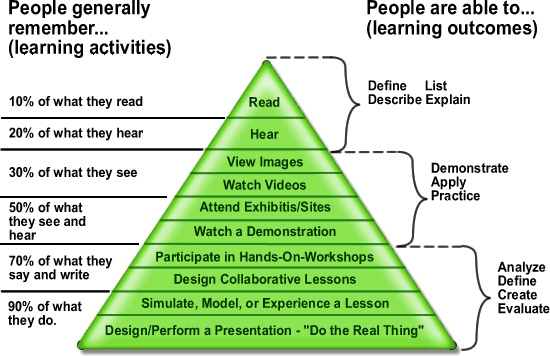
By Jeffrey Anderson – http://www.edutechie.ws/2007/10/09/cone-of-experience-media/, CC BY-SA 3.0, https://commons.wikimedia.org/w/index.php?curid=37711912
Workshops Are Not Lectures
A workshop is designed for:
- Exploration
- Discussion
- Co-creation
- Problem solving
- Skills practice
If the facilitator dominates the airtime, the session quietly shifts from workshop to presentation. Participants become passive and energy drops. Ownership disappears. The moment the facilitator talks more than the group, the dynamic changes from engagement to consumption.
The Wisdom Is In The Room
One of the core principles of strong facilitation is this; the room is smarter than the facilitator.
Workshop participants bring lived experience, context, expertise, and real-world challenges. When facilitators speak too much, they unintentionally override participant insights, short-circuit peer learning, and signal that the “right answer” comes from the front.
Silence, on the other hand, invites contribution.
Ownership Requires Voice
People support what they help create. When participants generate ideas, debate trade-offs, articulate decisions, and shape solutions, they feel ownership. But if the facilitator fills every silence, answers every question, or summarises too quickly, participants lose the opportunity to think out loud and build shared understanding.
Sometimes the most powerful facilitation move is simply asking; “What do you think?”
And then waiting.
Silence Creates Depth
Many new facilitators early in their career rush to fill any quiet moments in the workshop. After all, silence can feel uncomfortable. But silence does important work:
- It allows reflection
- It encourages the quieter voices
- It signals that thinking is valued
- It slows reactive responses
The Goal Is Capability, Not Dependency
If participants leave saying that “the facilitator was great but I’m not sure what we decided” then the session was a failure. Effective facilitation builds the group’s capacity to:
- Think clearly
- Navigate disagreement
- Make decisions
- Solve problems independently
- Commit to change
What Workshop Facilitators Should Do Instead
Speaking less does not mean doing less. Strong facilitators:
- Ask sharp, well-timed questions
- Clarify objectives
- Manage time and flow
- Surface patterns
- Create psychological safety
- Intervene when necessary
- Are not afraid to raise difficult issues
Essentially, a good facilitator will guide the process without dominating the content. However each facilitator will have their own specialist subject area and will be keen to impart some of their knowledge to the workshop participants. But it’s important to keep training points concise so that the real learning (conversations and shared experiences) has space.