
Category: Corporate Life

  • The Reason Most People Resign From Their Jobs

    The Reason Most People Resign From Their Jobs

    When organisations lose talented employees, the first question often asked is:

    “Was it the salary?”

    Sometimes the answer is yes.

    But far more often, the real reason runs much deeper.

    People rarely leave organisations because of one bad day or a single disagreement. They leave because, over time, they stop feeling that what they do matters.

    One of the most common reasons employees choose to resign is surprisingly simple:

    They no longer feel valued.

    People Don’t Just Leave Jobs. They Leave Experiences.

    There’s a famous saying in leadership:

    “People don’t leave jobs. They leave managers.”

    While that’s not true in every case, it captures an important reality. The daily experience an employee has at work is shaped largely by their immediate manager and the culture of the organisation.

    Employees who feel respected, listened to, and appreciated are far more likely to stay, even when work is demanding.

    On the other hand, when people consistently feel ignored, overlooked, or taken for granted, their emotional connection to the organisation begins to disappear.

    Once that happens, it’s often only a matter of time before they start updating their CV.

    Around 70% Leave Because They Don’t Feel Valued

    Research has consistently shown that feeling appreciated is one of the strongest predictors of employee retention.

    Several workplace studies have found that around 70% of employees who voluntarily resign say they did so because they didn’t feel valued or recognised by their employer. While different surveys report slightly different figures depending on the industry and methodology, the message is remarkably consistent: employees are far more likely to stay when they feel appreciated.

    This doesn’t necessarily mean employees expected constant praise.

    Feeling valued can be as simple as:

    • Being listened to.
    • Receiving constructive feedback.
    • Having achievements recognised.
    • Being trusted with responsibility.
    • Feeling included in decisions.
    • Knowing their work contributes to something meaningful.

    When these basic psychological needs are missing, motivation gradually fades.

    Salary Gets Attention. Appreciation Builds Loyalty.

    It’s easy to assume higher pay is the solution to employee turnover.

    Compensation certainly matters. Employees expect to be paid fairly for the work they do.

    However, once that expectation has been met, additional salary increases often have diminishing returns.

    A toxic culture with generous salaries rarely retains great people for long.

    Conversely, many employees remain loyal to organisations where they feel respected, challenged, and appreciated – even when they could earn slightly more elsewhere.

    People don’t simply work for money.

    They also work for purpose, belonging and recognition.

    Small Acts Make a Big Difference

    Many managers assume recognising employees requires elaborate reward programs or expensive bonuses.

    In reality, meaningful appreciation is often simple.

    Examples include:

    • Saying thank you.
    • Publicly acknowledging good work.
    • Asking for someone’s opinion.
    • Giving employees autonomy.
    • Checking in regularly.
    • Celebrating milestones.
    • Providing opportunities for growth.
    • Taking an interest in employees as people.

    These actions cost very little but can significantly strengthen engagement.

    Recognition isn’t about flattery.

    It’s about making people feel seen.

    Why Employees Stop Feeling Valued

    Feeling undervalued rarely happens overnight.

    Instead, it develops through repeated experiences.

    For example:

    • Good work is rarely acknowledged.
    • Feedback only comes when something goes wrong.
    • Managers are too busy to listen.
    • Employees have little influence over decisions.
    • Career development conversations never happen.
    • Successes are quickly forgotten.
    • Extra effort becomes expected rather than appreciated.

    Over time, employees begin asking themselves:

    “Does anyone actually notice what I contribute?”

    If the answer continues to feel like “no”, disengagement follows.

    The Cost of Losing Good People

    Replacing experienced employees is expensive.

    Recruitment costs, onboarding, lost productivity, and training all add up.

    But there’s another cost that’s often overlooked.

    When respected team members leave, they take with them:

    • Organisational knowledge.
    • Customer relationships.
    • Technical expertise.
    • Team morale.
    • Trust built over years.

    Remaining employees also notice.

    If high performers consistently leave, others begin questioning whether they should do the same.

    Turnover can become contagious.

    Creating a Culture Where People Want to Stay

    Retaining talented employees doesn’t require perfection.

    It requires intention.

    Leaders who successfully retain staff usually focus on creating an environment where employees:

    • Feel trusted.
    • Feel respected.
    • Understand how their work contributes.
    • Receive regular feedback.
    • Have opportunities to grow.
    • Know their opinions matter.
    • Celebrate successes together.

    When employees experience these consistently, they develop a stronger emotional connection to the organisation.

    That connection is often what keeps people committed during difficult periods.

    Leadership Matters More Than Perks

    Many organisations invest heavily in office upgrades, free snacks, games rooms, and wellness programs.

    While these initiatives can improve the workplace experience, they rarely compensate for poor leadership.

    Employees would often choose:

    • A supportive manager over a fancy office.
    • Genuine appreciation over branded merchandise.
    • Honest communication over expensive perks.
    • Trust over micromanagement.

    Culture is built through everyday leadership behaviours – not occasional employee events.

    Team Building Can Reinforce Appreciation

    One effective way organisations demonstrate that they value their people is by investing in meaningful team development.

    Well-designed team building programs do more than provide a fun day away from the office.

    They create opportunities for employees to:

    • Be heard.
    • Work collaboratively.
    • Discover each other’s strengths.
    • Build trust.
    • Celebrate shared achievements.

    Importantly, these experiences send a clear message:

    “Our people matter enough for us to invest in them.”

    When supported by good leadership back in the workplace, team building can strengthen relationships and reinforce a culture where employees feel genuinely valued.

    The Bottom Line

    Employees resign for many reasons. Career progression, relocation, family commitments, and salary all play a part.

    But one of the most common (and most easily preventable) reasons people leave is that they simply don’t feel valued. Indeed, this is the very reason I resigned from a particular organisation earlier in my career.

    Before I became an independent facilitator, I had held management positions in the hospitality industry. The salary was very fair, the benefits were good, and the physical working environment was extremely pleasant. But I couldn’t shake the feeling that my senior leaders simply didn’t care.

    There was a complete lack of connection from the senior leaders and this apathetic approach cascaded down to the middle management tiers as well. Everyone looked like they just couldn’t be bothered. They showed no interest in their own work and so certainly did not show any appreciation for those they managed. There was absolutely no engagement whatsoever from the senior management teams and, as Austin Powers famously did, I lost my mojo and ended up moving on.

    Every interaction between a manager and an employee sends a message.

    It either says:

    “You matter here.”

    Or it says:

    “You’re just another employee.”

    The organisations that consistently retain talented people are those where appreciation isn’t reserved for annual awards ceremonies or performance reviews.

    It’s part of everyday leadership.

    When people feel recognised, respected, and genuinely valued, they are far more likely to remain engaged, contribute their best work, and build long-term careers with the organisation.

    Creating that kind of workplace isn’t just good for employees. It’s good for business.

  • Why Your Team Needs Jargon-Free Fridays

    Why Your Team Needs Jargon-Free Fridays

    It’s far too common for communication to get tangled in a web of jargon, acronyms, and buzzwords. “Let’s circle back after we synergise on the low-hanging fruit” or “we’ll touch base offline and pivot as needed”. For some reason, the moment someone steps into a leadership position, phrases like this suddenly appear in their lexicon. It can become so second nature in corporate offices that many people no longer realise when they’re doing it. Even people who pass snide comments when others use a cliché will still throw their own clichés into the conversation without knowing it.

    But jargon often leaves people confused, disenagaged, and slightly embarrassed for the person who just said “Let’s think outside the box” when what they actually meant was “let’s come up with some creative ideas”. That’s where Jargon-Free Fridays come in.

    Gabrielle Dolan, an author, keynote speaker, and expert in business communication, is credited with inventing this concept in 2015 and there are some very amusing videos, like the one below, on her YouTube channel to illustrate just how ridiculous corporate jargon can be.

    What are Jargon-Free Fridays?

    Now that we’re all on the same page and singing from the same hymn sheet….(bugger, I couldn’t stop myself).

    Jargon-free Fridays is a simple, intentional practice: one day a week where everyone makes an effort to communicate clearly and directly, ditching the corporate clichés and unnecessary technical lingo. The goal is to cut out the bull**** and behave a bit more normally, as we would in real life, away from the office.

    On Jargon-Free Fridays, instead of saying “Let’s ideate on this and run it up the flagpole,” you might say “Let’s come up with a few ideas and share them with the rest of the team.” Simple and clear.

    Why It Matters

    The benefits of clear communication go beyond avoiding eye-rolls.

    • Improves understanding across cross-functional teams. Not everyone on your wider team may be fluent in the latest industry terms, internal acronyms, or niche technical language. This is especially true in remote or global teams. Jargon-free communication ensures everyone’s technical understanding.
    • Builds more authentic connections. It’s often the case that people use jargon to hide their true feelings. They may use clichés to mask their lack of comprehension or to avoid an uncomfortable topic. By speaking more clearly and openly with your team, you are helping to build trust.
    • Boosts productivity. Less time spent decoding what someone really meant in a message or presentation means more time getting things done. Clear instructions, straightforward feedback, and honest updates keep work moving efficiently.
    • Builds respect. When we hear others fill a conversation with jargon and cliches, we might start to wonder what they’re trying to hide. Are they using ambiguity to mask their own incompetence?
    • It’s just unnecessary. It does not make you look cool, professional, and well-informed. It’s often cringeworthy and can make you the target of office gossip and the subject of team jokes.

      How to Start Jargon-Free Fridays on Your Team

      The beauty of this idea is its simplicity. You don’t need a big rollout or a complex policy requiring three signatures of approval from successive levels of authority— just a bit of team interest.

      • Introduce the idea. Mention it during a team meeting or in a group WhatsApp message. Share why it matters and how it can improve communication and teamwork.
      • Set a playful tone. Encourage people to flag jargon when they hear it, in a friendly way, like a game of bingo. You could have a “jargon jar” and anyone caught using jargon on the day in question has to add a dollar to the jar. Profits could go to buying after-work drinks some time. Drinks next Wednesday sponsored mainly by our Director of Sales & Master of Clichés, John….
      • Lead by example. Use clear, plain language in your Friday emails, reports, and meetings. When giving feedback or assigning tasks, focus on clarity over cleverness.
      • Make it visible. Remind your team with a recurring calendar event. The more visible and consistent it is, the more it’ll stick.

      Final Thought

      I think if you suggested reducing the use of jargon in your office, most people would agree that it’s a good idea. Everyone seems to hate it and it has become a running joke in workplaces around the world. Yet teams and leaders continue to speak in riddles like some medieval wizard.

      Try Jargon-Free Fridays and see how refreshing it is to swap “Let’s circle back after we’ve increased our bandwidth” for “Let’s talk about this when we’ve got more time.”

    1. What’s the Ideal Team Size?

      What’s the Ideal Team Size?

      Team Building by Numbers

      Putting the right number of people on a work team is perhaps the most basic of steps towards ensuring efficiency and good decision-making. Yet so many managers get it wrong.

      Teams are simply getting too big. For example, managers will often add people to a leadership team so that the individual is not offended by being left out. Being part of the executive leadership team is seen as a badge of honour, a reward for good performance. The reality is that not everybody needs to be there and it might be beneficial to do some pruning.

      In my early career, in hospitality, I saw important decision-making meetings in which 17 people were squeezed around the table. The idea being that since the topic was important and crucial decisions needed to be made that everyone should have a say in the outcome. A lot of managers will do this because they believe it’s good for teamwork to include everyone. It makes each individual feel valued.

      You can probably guess though what happened in that meeting. It descended into an argument. Was a decision made? Absolutely not.

      It was one of those meetings which gives meetings a bad name. It was the reason why people hate meetings. If you asked everybody whether they wanted to be in that meeting, a lot of them would answer ‘no’.

      What Happens When a Team Is Too Big?

      A Harvard professor, Chris Argyris, put forward the idea that, within a team, individuals have to use both ‘advocacy’ and ‘inquiry’ during discussions. For me, as a Brit, he spelled the second word incorrectly but I won’t blame him for that – the concept is great. But from this point, for my own sanity, I’ll spell it as ‘enquiry’ – the correct spelling…

      To define these terms, advocacy means to state one’s opinion directly while enquiry refers to asking questions of others to clarify their statements.

      When a team is the right size, team members have the opportunity to make enquiries of one another. They ask questions in order to improve understanding. They listen to understand.

      But when there are too many people in a team, there is no time to do that. Everyone wants to have their say and there are a lot of opinions to get through. People realise that if they want their opinion heard, they will have to take what little opportunity they have to speak directly and advocate for their position, not use their time clarifying someone else’s thoughts. It’s dog eat dog.

      In smaller teams however, team members know that they will have plenty of time to share their own thoughts so are happier to explore other’s ideas as well. These teams engage in dialogue in which ideas are shared and explored rather than a debate in which each person strongly argues for their own side.

      Too Many Cooks

      We all know the phrase about there being too many cooks in the kitchen. Everyone has a different opinion and no decisions can be made.

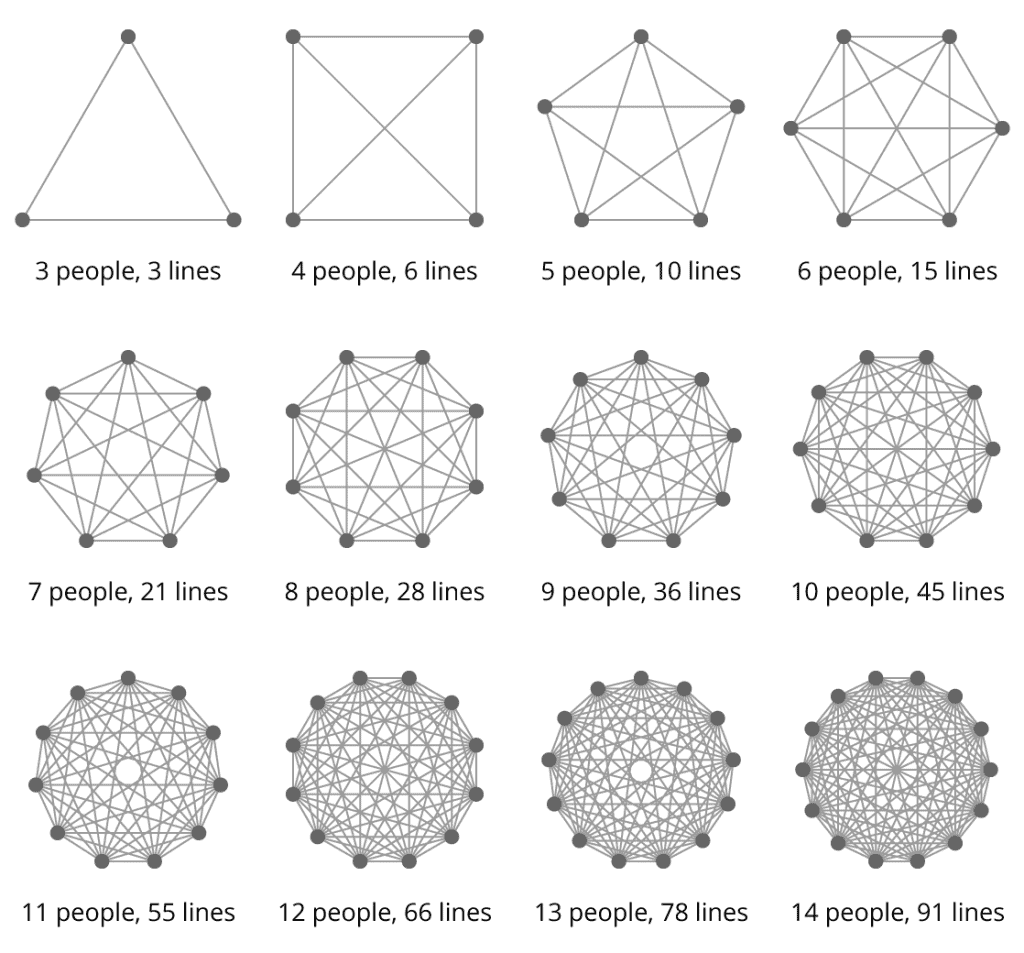
      The image below shows what happens when you start adding too many people to a team. Lines of communication increase exponentially. It’s chaos. There is simply no way that meaningful discussions can take place when you’ve got 10 to 20 people in a team, all trying to be heard.

      (source: Lighthouse)

      Striking a Balance for Ideal Team Size

      A figure that is often thrown around is teams should be between 6 and 8 people. This makes sense. A team of this size will be big enough that it has a certain amount of energy and enthusiasm while at the same time allowing for each individual to have their say as well as make enquiries of others.

      Jeff Bezos, the founder of Amazon, famously invented the ‘2 pizza rule’ which stated that no team meeting should be so big that two large pizzas could not feed everyone. In some cases, and if it was a smoked salmon and four cheese pizza, this might suggest that a team should not have more than 3 people…

      Normally though, the 2 pizza rule would probably fit with the 6-8 person range mentioned above. Other numbers that have been mentioned in the literature are 3-9, less than 10, 5, 4-5, and 4.6.

      It seems that, like many teams, academia can’t agree!

      So, I’m going to make a bold quantifying statement. Work teams should be made up of 7 people. There, I said it.

      No arguments.

    2. A Personal Rant: There is Most Certainly an ‘I’ in Team

      A Personal Rant: There is Most Certainly an ‘I’ in Team

      It’s a Huge Cliché

      “There ‘s no ‘I’ in team.”

      Scroll through LinkedIn and you will find managers and leaders across the world quoting this famous saying as if they’re being paid for it. It’s printed off on sheets of A4 and pinned to noticeboards in offices everywhere. It’s emblazoned on company t-shirts during annual off-sites. And it’s used to end speeches with the belief that it’s mighty and profound.

      Please stop. It really annoys me.

      Good Intentions. Poor Results.

      I understand what’s behind it. It’ s a way of showing that we’re all in it together. We’re all working towards that common goal. We’re all cogs in some highly efficient machine, working seamlessly together, never putting individual needs above the team’s.

      I feel, though, that it’s way too simplistic and inadvertently hides the real strength in teams. That strength is the individuals within it. The ‘I’s and the ‘Me’s. And this trite phrase seems to suggest that the individuals are unimportant.

      It’s the individuals that lead to a team’s success or failure. Individuals with different skill sets, different knowledge bases, different opinions and different ideas. Each individual within a team brings their own technical skills to the job as well as unique career experiences and varying personalities and leadership styles. Don’t take that away. Diversity of team members is crucial.

      Not All Sheep

      On one of several management training courses I attended in my early career, each project team was asked to conceptualise a new theme for a luxury restaurant and then present our concept to the panel of decision-makers.

      My team worked on this throughout the afternoon and evening ready to present the next morning. We all had our roles. One person (an IT specialist and Google whizz) was the researcher. One person (a marketing executive) was responsible for creating the Powerpoint presentation. Another team member was good with words thanks to her career in public relations. We also had a CSR professional in our team who took charge of the community-related aspects of our restaurant. They produced some outstanding work. The rest of us pitched in where we could and we came up with what we thought was a great concept.

      The next day, and with the full agreement of my team, I presented the concept to the panel while my teammates stood off to the side. I’m a strong public speaker. I have a great deal of experience speaking to groups (it’s my job as a trainer) and the plan was for me to present in the manner of Steve Jobs. I didn’t wear the black turtleneck though because, well, I would have looked like an idiot.

      Anyway, the presentation went really well and the board loved our team’s concept. Unfortunately, we were marked down heavily because I presented alone.

      We suggested to the board that it was not a team project in junior school in which everyone has to take turns and get their first experience of public speaking. This was a professional presentation and we were all in our late twenties or early thirties. We had selected the best person to present (that just so happened to be me), just as we had selected the best person in every other role such as research, media creation and content. We each had our own skill set and applied those skills in the relevant areas – all towards our team’s shared goal, the creation of an awesome sales pitch. Their response? “In our company, there is no ‘I’ in team.”

      A bit silly if you ask me.

      The Long Road to Revenge

      Having each team member do what they were best at enabled our team to produce a high-quality presentation. I’m confident in saying that it was the best of the day with an engaging presentation, riveting visual aids, and impactful content, all backed up by accurate research and data.

      We all had our specialist roles and we worked together, as a team, towards our shared goal. There was certainly one fully-aligned team but there were several ‘I’s within it.

      And this is my point. Remember that there are powerful and impactful individuals in every great team. They need to be celebrated and encouraged, not put in a grey suit so that they are the same as everyone else. Which is better? One experienced and polished public speaker making this important presentation to a panel of senior leaders with the trust of their team or a collection of six visibly nervous individuals who keep tripping over their words and can’t get the message across?

      My team did not win that competition and the prize was beer. I remain bitter to this day and this post is the first step of my twenty seven-step plan for revenge.

      This is one rant in a series of personal rants and diatribes about silly and ineffectual behaviours displayed by leaders and managers across the world. Please don’t expect in-depth psychological analyses and discussions of empirical training models here. I write these posts for my own light entertainment and, I hope, yours.

    3. A Tip For Your Next Team Offsite in Thailand

      A Tip For Your Next Team Offsite in Thailand

      Finally, Some Face-to-Face Interactions

      This year, I’ve been working with a lot of tech companies. While many industries (hospitality and aviation especially) were devastated by the Covid-19 pandemic, tech companies thrived as more and more companies shifted their operations online and more people migrated their lives to the cloud (more so than before). Work From Home (WFH) quite suddenly became the norm.

      I worked with a tech company this last July who told me that they had grown 300% between 2020 and 2022 in terms of number of employees. Great news for them of course. But, it presented a problem. Many of these new employees had only ever met their new colleagues through a screen. While they had certainly built some good relationships online, the senior leaders of these organisations felt (rightly so in my opinion) that some real, face-to-face interactions were necessary. Humans are social creatures after all.

      This is why, when Thailand properly opened its borders on July 1st, I’ve been working with a lot of techies and software engineers.

      Team offsites are a wonderful way to form new relationships and strengthen old relationships while spending a few days out of the office in an exotic location. Sure, there’ll be meeting and serious conversations during those few days but one of the biggest benefits of team offsites is relationship building.

      A Tip For Organisers

      So, I said I had a tip. Here it is.

      Don’t try to include too much.

      I had an enquiry recently where the organiser said “we might be able to find 30 minutes for team building”. Over 4 days in Phuket, they only had 30 minutes available for team building, maybe. The rest of the time was taken up by meetings, some more meetings, and one or two meetings. In the end, they couldn’t even find the 30 minutes so we were not able to work together.

      I also recently worked with a company that had planned several days in Bangkok to align with the release of their new app. The week was not taken up with meetings but filled with tours, excursions and a team building session with me. The three days were like a military operation and delegates were ferried around Bangkok from one experience to another. When one thing ended, another began.

      The feedback from delegates was always the same. They all wished they had a little more free time to do a bit of shopping, have a walk, have a nap, enjoy a massage, explore the city, or just chill by the pool for an hour or two.

      One lady had come all the way from Turkey and it was her first time in Thailand and Asia. Unfortunately, she spent so much time in a van being transported through Bangkok traffic that she didn’t even have time to buy a souvenir or see one of the famous Thai temples she’d heard so much about. She could though talk at great length about the interior of a Toyota Commuter minivan.

      I realise that when organising an offsite, team leaders want to maximise their time in their new location. After all, these things are expensive and hard to arrange. But, relationships are not built when people are utterly exhausted. Introverts especially require time to recharge in between team activities.

      I also get that the meetings are important. It’s your only opportunity to get together and discuss important issues directly. This is crucial, I fully agree. This is why you spend many thousands of dollars on offsites – because you see the value of personal communication, idea sharing, and open environments in which participants can ask questions directly to senior leadership.

      I’m not suggesting that you bring people all the way to Thailand and then just allow them to mope around the hotel all day and hide away in their rooms responding to emails. For sure, include the excursions, team dinners, crucial meetings, and a team building program. This is what it’s all about – shared experiences.

      Just don’t forget about the power of downtime. Just a couple of hours here and there will be appreciated by everyone. Downtime will keep delegates fresh and fully enagaged. So, when you do have a three hour presentation on the financial implications of a new set of branded pencils for head office, people will be at their best.