
Team Development & Leadership Training Workshops
I design and facilitate experiential learning workshops focused on team development and leadership. These workshops are based on the concept of action learning and so are fully interactive and will be customised to fit your training or meeting goals.
Availability: Bangkok, Phuket, Singapore, Kuala Lumpur. Pretty much anywhere in Asia!
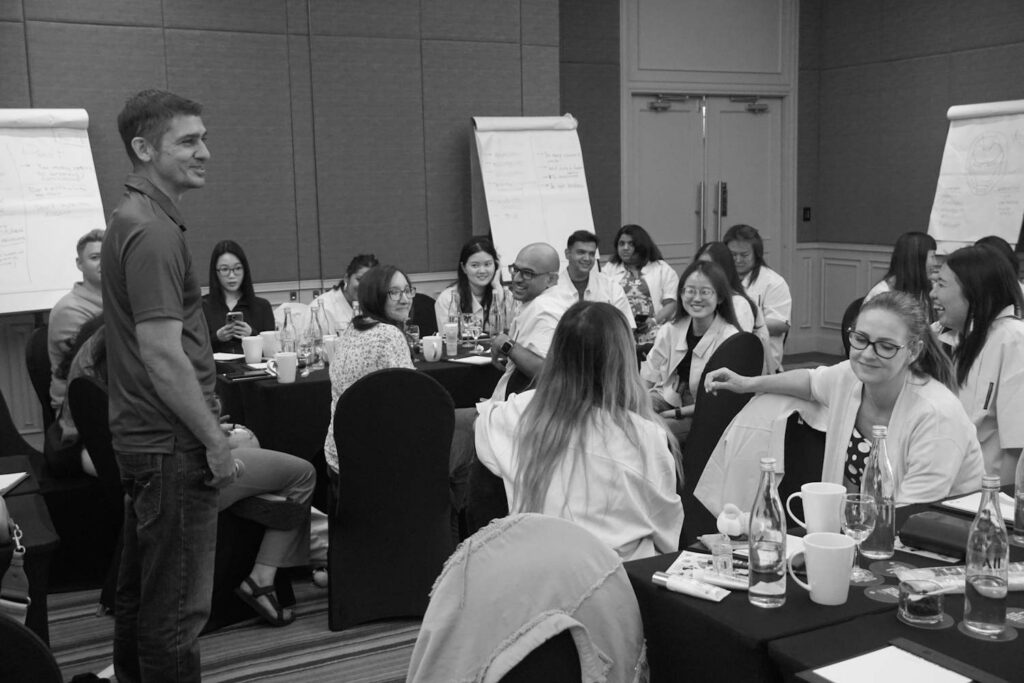
Half-Day and Full-Day Training Workshops
I want my workshops to be fun and engaging. You should expect plenty of team challenges, partnered activities, individual thought, and insightful discussions. It’s a process called ‘action learning’ and the result is more impactful team training experiences.
There are no boring Powerpoint presentations and endless lectures. In my workshops, the group does 80% of the talking. The participants will problem-solve both individually and as a group.
As your facilitator, my focus is on the group learning process and I will guide the group through structured activities, facilitate meaningful discussions, and draw out the group’s collective knowledge.
Learn more about my facilitation work in Bangkok and Phuket
Learn more about my facilitation work in Singapore and Malaysia
“Thank you for your wonderful facilitation. Everyone was engaged with high energy levels and the workshop really delivered.”
WL Gore
Request Workshops Menu
Complete this form to be sent a PDF menu and price list for my team development and leadership training workshops.
Training Workshops FAQs
Which is better, a half-day or full-day workshop?
There’s no right answer here. If you’ve only got a half-day available then that’s the best option. I design my workshops to get straight to the heart of the matter and there is a lot we can achieve in a succinct 3-4 hour session. But if you do have a whole day available then we can certainly go into more detail and cover a few more topics.
Can I combine a workshop with some fun team building?
Absolutely. This is a common way of doing things. Many of my clients arrange a training workshop in the morning followed by lunch and then a fun indoor team building activity in the afternoon. I always recommend doing the serious stuff first though so that concentration levels are at their highest.
Are the workshops engaging?
I always do my very best to keep workshops engaging. It’s incredibly important to me in both my training workshops and my team building programs. My workshops are highly interactive (they’re not lectures) and I take great care to design team and/or individual exercises that deliver real results. These action learning activities are combined with interesting case studies, my humour-driven presentation style, and honest opinions that often challenge traditional thinking.
Where are your workshops available?
My training workshops are available pretty much anywhere. My home base is in Thailand so I am frequently facilitating in either Bangkok or Phuket. However, since workshops do not have large volumes of equipment and huge staffing requirements (unlike team building programs) I frequently facilitate across Asia, particularly Singapore and Kuala Lumpur, both cities being just a short flight away. I’ve been accumulating frequent flyer miles for many years.
How much do you charge for a workshop?
I have fixed facilitation fees in place for groups up to 20 participants. Above 20 pax, there is an additional per person fee. Request a copy of my workshops menu for a full fee breakdown.
Which venues do you work with?
I can work with you at whichever venue you prefer. This is often a hotel meeting room. You would need to make all room and setup arrangements such as table setup, AV, microphone, flipcharts etc. However, I am happy to visit your office and work with you on-site.
“Alun immediately built a great rapport with the group and was engaging, fun and a pleasure to work with.”
AWS
Customisable Training Sessions
Each organisation I work with is different. Teams are highly dynamic systems and group goals often vary. Some of my most popular workshop topics are introduced below and you can follow the links to read further details about each workshop. Then, request a copy of my workshops menu to see my facilitation fees.
Team collaboration using DISC
Working as part of a team, where each team member brings their own personality, working style, needs, and fears, can be tough. It’s a lack of understanding as to why people are like they are that can lead to frustration, conflict, avoidance, and poor collaboration. The DISC assessment builds greater understanding of each other’s working styles and highlights how we can each adapt our behaviour and communication to aid team synergy.
The five dysfunctions of a team
It’s said that 90% of business teams underperform. There are common reasons for this underachievement and each inadequacy snowballs from the one before it, creating a serious barrier to effective collaboration and the pursuit of a team’s goals. The Five Dysfunctions assessment will highlight where your team is currently excelling and where you’re struggling. With this knowledge, strategies can be formulated to help overcome each dysfunction, going right back to the foundational level of trust.
The ideal team player
The Ideal Team Player workshop explores the personal qualities that make someone an exceptional team member. It serves as a companion to The Five Dysfunctions of a Team, focusing on individual behaviours rather than team dynamics. When someone embodies all three traits, they become a true “ideal team player.” Missing, or underdeveloped traits, can lead to predictable challenges within the team and ultimately prevent effective collaboration. This assessment reveals where each team member should focus their self development.
Building the best version of our team
When teams have been together for some time, they often get stuck in their ways. Routines become embedded, goals can become fuzzy, motivation slips, and bonds between team members could do with a bit of attention. This workshop is like a Ctrl-Alt-Del for your team as we refresh things and develop “version 2.0” of your team.
Bridging organisational silos
As departmental teams focus on their own responsibilities and fight their own fires, indifference and even resentment towards other departments can grow. Clear communication and a shared sense of purpose can help to break down these barriers.
Minimising and managing conflict
Workplace teams are dynamic. Things happen. Stuff comes up. So when you have a mix of characters, work styles, ideas, skill sets, cultures, and individual moods on any given day, conflict can easily present itself. High-performing teams learn to deal with it.
Clarifying team culture and values
Sometimes, it’s good to go right back to the start and remind teams of their underlying values, vision, purpose, and goals – especially if they’ve evolved over the years. This is how strong company cultures develop.
Building your personal brand
People like doing business with people, not anonymous email addresses, so a strong personal brand builds trust. Think of it as your professional reputation and what you want to be known for. This workshop will help you understand, define, and communicate your personal brand with clarity and, most importantly, authenticity.
Idea generation and group planning
Facilitation can help greatly when a team wants to generate ideas, solve problems, and make good decisions. This fully-facilitated process will surface
underlying knowledge, help groups plan collaboratively, and leave the meeting room with a sense of purpose and a clear implementation plan.
Engineering an improved team operating system
A team’s operating system (OS) refers to the internal work processes, procedures, policies, and habits that are currently in place – the manner in which individuals and departments collaborate with one another. But sometimes, the way things are normally done may not be the best way.
Enhancing the customer experience
How do some businesses stand out in the crowd and keep their customers coming back again and again? The secret lies in their commitment to understanding the weak points in their customer’s journey from the initial impression through to the crucial after-sales service.
Leading and facilitating teams
It’s all very well promoting people into management positions after they have performed well in their current role. But team leadership is new and often dangerous territory and without adequate training, new leaders are being set up to fail. The leadership behaviours and techniques covered in this workshop will make new leaders more effective in facilitating their team’s success.
Identification of underlying issues
Externally-facilitated workshops offer a psychologically safe environment in which to raise any underlying issues and highlight what might be holding a team back. Take the opportunity to speak openly and honestly.
Team leadership using DISC
Building upon the “Team collaboration using DISC” workshop, this session takes things a step further and investigates how one’s DISC style influences leadership style. There are lessons to be learned from each of the eight DISC leadership styles and combining the best bits creates well-rounded leaders.