Category: Teambuilding

  • Team Building in Phuket: The Beach Might Not Be The Best Option

    Team Building in Phuket: The Beach Might Not Be The Best Option

    When people think about team building in Phuket, the beach is often the first thing that comes to mind. Indeed, it is perhaps what Phuket is most famous for. Put a group of colleagues on the beach, add a few team challenges and you’ve got what looks like an acceptable corporate team building event.

    But the beach isn’t necessarily the best place to do team building.

    Quite often, the beach is chosen because the company is in Phuket rather than because it is the right environment for the team building itself.

    The beach looks great in the brochure

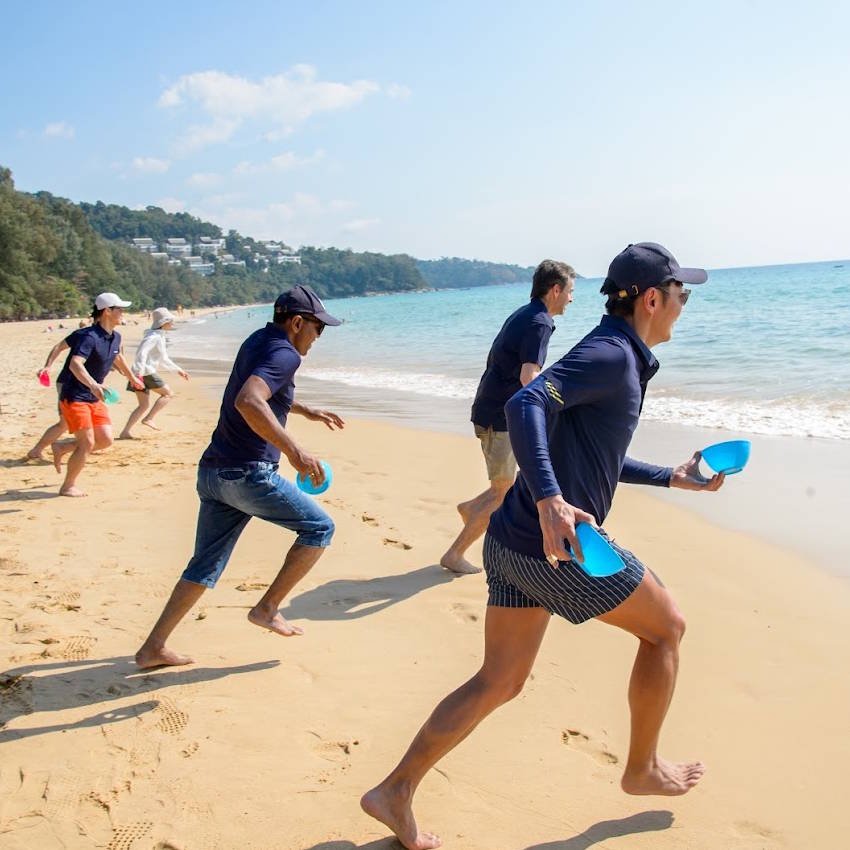
    A photograph of 40 employees running along a tropical beach looks much more exciting than a photograph of 40 employees in a hotel meeting room.

    This creates a temptation when planning corporate events in which the destination becomes part of the marketing and the beach becomes part of the experience.

    And before long, the assumption becomes:

    “We’re in Phuket, so we should do something on the beach.”

    But a good team building program shouldn’t start with the location. It should start with (a) the objective and (b) the specifics of your group.

    The answer should influence the activity and the location, not the other way around.

    Phuket’s weather can be a problem

    This is the obvious one. Phuket is tropical. That means hot, humid weather and a distinct rainy season. Even outside the rainy season, you can have a perfectly sunny morning followed by a sudden downpour.

    For a tourist deciding whether to spend an afternoon on the beach, this isn’t necessarily a major problem but for a corporate group of 60 people with a carefully planned program, it can be.

    Imagine you’ve booked:

    • A beach location
    • Equipment
    • Transport
    • Catering
    • Staff
    • A photographer
    • Several team activities

    And then it rains. Unfortunately, “everyone back onto the bus” isn’t always a particularly inspiring team building activity. Neither is “let’s move to the meeting room and play some silly games because we don’t have any equipment that we can set up indoors.”

    A well-planned program should have a realistic contingency plan. Sometimes that means moving indoors from the very beginning.

    Heat can affect participation

    Phuket can get very hot. And while some people will happily spend several hours running around on a beach in tropical heat, others won’t.

    That’s particularly relevant for international corporate groups. Participants may be arriving from countries with very different climates.

    Some may be perfectly comfortable while others may be sweating before the first activity has even started.

    Heat also affects the way people participate.

    If participants are physically uncomfortable, tired or dehydrated, their attention is likely to move away from the activity and towards finding some shade and a cold drink.

    It’s also a safety issue. Heat exhaustion and heat stroke can come on very quickly, often without notice.

    Not everyone wants to run around on a beach

    Corporate groups are made up of lots of different people with varying ages, fitness levels, personalities, competitive spirit, and preferences.

    Some participants would rather solve a problem or attempt a creative challenge than race across the sand.

    I’m not saying that you should avoid physical activities. I just mean that you shouldn’t assume that physical activity = good team building.

    Beaches can be inconvenient

    There is a practical issue. Are there toilets, changing facilities, refreshments, shade, and storage for personal belongings?

    Think how many participants have entered the sea with their phone in their pocket. Or lost their wedding ring somewhere in the sand. These sorts of things happen more often that you might think.

    Sometimes the activity itself is unnecessary

    Years ago, one group insisted to travel for 45 mins by speedboat to an island, play a game for around 30 mins, and then travel 45 mins back to their hotel. What was the point?

    They could have had a far more enjoyable and engaging activity in their hotel grounds. Or, alternatively, they could have removed the team building game entirely, and enjoyed a 2-3 hour speedboat tour instead.

    I’ve had other organisers ask for team building activities during cocktails on a very expensive luxury yacht. This may sound like a cool idea from the organiser. In reality though, the participants would most likely prefer to enjoy the champagne, chat with colleagues, appreciate the views, and have a swim.

    I often recommend to clients who bring me these types of requests that they should choose one or the other. If you want to experience the amazing islands you should perhaps book a boat tour and experience them properly without trying to squeeze in games along the way.

    If you want to take your group on a luxury yacht, take advantage of the yacht’s facilities and the stunning views. Preventing your colleagues from fully enjoying the yacht experience by organising a game of hula hoop relay is perhaps not a wise decision.

    There’s most certainly a place for beach and island-based activities. A shared team bonding experience simply exploring the islands can be extremely effective. And, if you have a full-day available, it is certainly possible to design an awesome speedboat amazing race event (because you’ve got the time to do it properly and have the best of both worlds).

    But always consider whether the beach environment is necessary or worthwhile if you’re looking for an engaging team building event.

    You don’t need a beach to create energy

    There is a common assumption that indoor team building must be dull. Hotel meeting room, tables, chairs, PowerPoint etc.

    It doesn’t have to be like that.

    A well-designed indoor team building program can be highly energetic and super fun. I’ve got several awesome indoor team building programs in my menu as well as loads of options that operate entirely within hotel grounds.

    The energy comes from the experience, not necessarily from the scenery.

    I’ve run activities where participants have been far more animated inside a meeting room than they would have been standing on a beach in the sun. And, in my experience, a lot of people express their relief when they discover that they are in the air-conditioning!

    Indoor team building can actually offer more flexibility

    There is another advantage to using a hotel or meeting venue. You have greater control.

    You control the environment.

    You can control the equipment.

    You don’t have to worry about tides, weather or excessive heat.

    You can move from one activity into a discussion without relocating the entire group.

    You can use audio-visual equipment if necessary.

    And if you need five minutes to debrief an activity, everyone can simply sit down.

    This can make a significant difference when the program has a genuine team development objective.

    So when is the beach a good idea?

    I’m not suggesting that beach team building is always a bad idea.

    Far from it.

    A beach can be fantastic when the activity genuinely suits the environment.

    For example, if you want a highly energetic, informal session with a strong social element, the beach can be ideal.

    It can also work particularly well for activities involving:

    • Physical challenges
    • Team races
    • Building or construction challenges
    • Environmental activities
    • Large-scale competitive games

    And if the company’s main objective is simply to get everyone away from their desks and have some fun together, the beach may be exactly what they want.

    The key is to be clear about the purpose.

    Ask this question before booking a beach activity

    Before choosing the beach, ask:

    “Would we choose this activity if we weren’t in Phuket?”

    If the answer is no, that’s worth thinking about.

    Perhaps you’re choosing it because it looks impressive in photographs. Perhaps everyone assumes that a Phuket corporate event should involve the beach. Perhaps your hotel recommended it.

    None of those are necessarily good reasons.

    Instead, start with the team.

    • What do you want people to experience?
    • What behaviours do you want to develop?
    • What kind of interaction do you want?
    • What will make the participants actually engage?

    Then choose the environment.

    The best location is the one that fits the objective

    Sometimes that will be a beach. Sometimes it will be a hotel garden. Sometimes it will be a conference room.

    There is no prize for doing team building on sand. The purpose of team building isn’t to prove that your company has travelled to Phuket.

    It’s to create an experience that helps people work better together and provide a memorable shared experience.

    So when you’re planning team building in Phuket, don’t automatically ask:

    “What can we do on the beach?”

    Ask a more useful question:

    “What kind of experience will be most valuable and be the best fit for this team?”

    If the answer happens to be the beach, cool.

    If it happens to be an air-conditioned meeting room or a hotel lawn, that’s fine too.

    The palm trees don’t have to be involved.

  • Why People Hate “Forced Fun” Team Building

    Why People Hate “Forced Fun” Team Building

    “We’re going to have some fun!”

    It’s a phrase that’s often heard at the start of corporate team building events, company away days, and staff parties. Yet for many employees, those words are enough to fill them with dread.

    Patrick Lencioni, one of the world’s most well-known experts on organisational health has long argued that organisations should focus on building healthy teams rather than relying on superficial or ‘forced fun’ activities to improve teamwork.

    Healthy teams will naturally have more fun than unhealthy teams anyway. He has also said that forcing people to participate in awkward or embarrassing activities can actually undermine trust rather than build it.

    I’m with Patrick on this.

    Even though I run a team building company, the thought of forcing people to do silly chicken impressions, behave like a monkey, or take off most of their clothes (yes, I’ve seen all of these ridiculous things attempted) makes me cringe. Unfortunately, bad experiences like this have turned many people into team building skeptics.

    Nobody should ever be made to feel awkward, embarrassed, or uncomfortable.

    The Problem with Forced Fun

    We’ve all experienced it.

    The organiser is enthusiastic. The music is loud. The facilitator tells everyone to “let loose” and “step outside your comfort zone.”

    Meanwhile, half the room is wondering how quickly they can disappear for another coffee.

    The issue isn’t that people dislike fun. Quite the opposite.

    People love laughing with colleagues, sharing experiences, and celebrating success together. What they don’t enjoy is feeling that they’re expected to have fun on command.

    As A Facilitator, Consider The Introverts

    Just because some event leaders (who are perhaps raging extroverts themselves) personally enjoy doing the chicken dance and find it fun does not mean that everyone will. Especially the introverts or the more shy members of the group.

    An experienced facilitator knows this and will design activities that are suitable for all and facilitate them in an engaging manner.

    I am not saying that introverts can’t have fun. Everyone can and does have fun. But the fun needs to come from an authentic place. It comes down to the activity design and the opportunities for fun that it creates naturally.

    I’ve seen a lot of facilitators get this wrong. Play a silly game and try to create fun by shouting and screaming. It can appear childish. And introverts hate appearing childish.

    An experienced facilitator often underplays things and allows the activity to do the work of creating fun times. Always allow an opportunity for people to opt in or opt out.

    The concept of forced fun does not apply to introverts!

    Fun Is a By-product, Not an Objective

    The best team building activities rarely begin with the goal of making people laugh.

    Instead, they give people an interesting problem to solve, a challenge to overcome, a mystery to unravel, or a goal worth pursuing.

    When people become absorbed in working together, something interesting happens. They stop worrying about whether they’re supposed to be enjoying themselves and the enjoyment appears naturally.

    Laughter becomes genuine rather than polite and conversations become spontaneous. Fun emerges because people are engaged, not because someone told them to smile.

    On a management training course I attended early in my career, one of the energisers was to walk around the room fake laughing at one another in an over-the-top manner. The intention was to force people to laugh and then this would encourage even more laughter. Everyone hated it. Imagine trying to get that famous grumpy cat from Instagram to do it. That’s what it felt like. It was just awkward and cringy. You could see the embarrassment on everyone’s faces.

    Why Adults Resist Forced Activities

    Most people can immediately recognise when an activity feels artificial or has been designed purely to manufacture enthusiasm.

    This is especially true in the workplace.

    People are conscious of how they’re being perceived by colleagues, managers, and senior leaders. Nobody wants to look foolish in front of the people they work with every day.

    The more pressure there is to “join in”, the more uncomfortable some participants become. Ironically, the harder you try to create fun, the less enjoyable it often becomes.

    Good Team Building Doesn’t Feel Like Team Building

    One of the nicest compliments I receive after an event is:

    “I wasn’t expecting to enjoy that as much as I did.”

    That’s because my aim isn’t to force enthusiasm. It’s to create an environment where enthusiasm develops naturally.

    Give people an engaging challenge that you, as the facilitator, has designed and thought about in depth, make the rules clear, encourage collaboration, and keep everyone involved.

    Then stand back and let the experience do the work.

    By the end of the activity, people are laughing, celebrating, encouraging one another, and talking about what just happened – not because they were told to, but because they genuinely enjoyed themselves.

    It’s About Psychological Safety

    There’s another reason forced fun often fails.

    People need to feel safe before they’re willing to participate wholeheartedly. If they’re worried about embarrassment, failure, or being singled out, they’ll naturally hold back.

    That’s why the best facilitators spend just as much time creating a comfortable atmosphere as they do explaining the activity itself.

    When people know they won’t be judged, they’re far more willing to contribute, experiment, and enjoy the experience.

    The Role of the Facilitator

    The activity matters. But the facilitator matters even more. The same challenge can feel awkward in one room and unforgettable in another.

    An experienced facilitator knows when to encourage, when to step back, when to increase the energy, and when to allow quieter moments to develop naturally.

    The goal isn’t to become the centre of attention. It’s to create the conditions where the experience becomes the centre of attention. A skilled facilitator can manage this smoothly, allowing genuine fun to arise authentically, not manufacturing forced fun.

    The Best Fun Is Never Forced

    People don’t remember a team building event because someone told them to have fun. They remember the moment their team solved an impossible challenge. The unexpected idea that changed everything. The colleague who surprised everyone. The shared laughter after something went spectacularly wrong.

    Those moments can’t be scripted and they can’t be demanded.

    They simply happen when people are given the right environment, the right challenge, and the freedom to enjoy the experience in their own way.

    That’s why I never try to create forced fun. I simply create the conditions where genuine fun has every opportunity to emerge.

  • The Importance of Downtime in a Multi-Day Team Building Retreat

    The Importance of Downtime in a Multi-Day Team Building Retreat

    When organisations plan a multi-day team building retreat, there’s often a temptation to fill every hour of the schedule.

    A team building activity after breakfast.

    A workshop before lunch.

    Another activity in the afternoon.

    Dinner followed by evening entertainment.

    Repeat the next day.

    On paper, it can look like excellent value for money. Every minute has been accounted for, and every session has a clear purpose.

    In reality, though, an over-packed itinerary can work against the very outcomes you’re trying to achieve. Sometimes, the most valuable part of a team retreat isn’t a structured activity at all.

    I like to chat with my event participants whenever I get the chance and I’m often asked for suggestions for things to see or do in the area. But once we get talking, it turns out that their biggest challenge is finding the time to do anything other than what their event organiser has pre-arranged.

    I remember chatting with a couple of ladies from the Philippines at the end of one of my team building programs in bangkok. They told me that it was their first time in Thailand and they were disappointed because they hadn’t seen or experienced anything outside of their hotel.

    I also frequently see group schedules that have been completely filled and planned right down to the minute. This never works. If you don’t build in some leeway with your timings, I can guarantee that you will always be running late. The result? Participants hurrying from session to session without any chance to unwind. This is not the right environment for effective relationship-building.

    Teams Need Time to Process

    Great team building isn’t just about what happens during an activity. It’s also about what happens afterwards.

    When participants have time to reflect, they naturally begin discussing what they’ve learned, sharing different perspectives, and connecting the experience to their day-to-day work.

    These conversations often happen over coffee, by the pool, during a walk around the resort, or while waiting for dinner. They’re informal, but they’re incredibly valuable. Without downtime, teams move straight from one activity to the next without giving themselves a chance to absorb what they’ve experienced.

    Relationships Are Built Between the Sessions

    As a facilitator, I’ve seen countless examples of colleagues who barely knew each other at the start of a retreat become good friends by the end.

    Interestingly, many of those relationships weren’t formed during a challenge or workshop.

    They were built during the quieter moments. Sitting together over lunch. Chatting while watching the sunset. Sharing stories over breakfast. Taking a walk around the resort.

    These relaxed conversations help people see each other as individuals rather than simply job titles or departments.

    That understanding often carries back into the workplace long after the retreat has finished.

    Avoiding Information Overload

    Leadership workshops, communication training, and team development sessions require concentration. If participants spend eight or nine hours each day moving from one learning session to another, their ability to absorb new information gradually decreases.

    There’s a statistic that I use as a guide in my training workshops. Adult humans can learn effectively for a maximum of four hours before they need a good break. A half-day session fits perfectly with this.

    By allowing time to recharge, you’ll often find that people return to the next session more engaged, more focused and more willing to contribute.

    Sometimes, doing less actually results in learning more.

    Downtime Doesn’t Mean Wasted Time

    Some organisers worry that free time will lead to participants disappearing to their rooms or spending hours on their phones.

    In practice, that’s rarely what happens.

    Given the opportunity, many colleagues naturally gather together. Some head to the swimming pool. Others visit the beach. Some explore the local area or go shopping together.

    Others simply sit together with a cocktail and continue conversations that began earlier in the day.

    These moments strengthen relationships in ways that can’t always be replicated through structured exercises.

    The Venue Becomes Part of the Experience

    One of the advantages of holding a retreat in a destination like Phuket is the environment itself. Many resorts offer beautiful gardens, swimming pools, beachfront settings, and relaxing communal spaces.

    If participants never have time to enjoy these facilities, you’re missing one of the biggest benefits of taking the team away from the office.

    The change of scenery helps people switch off from their daily responsibilities and return with a fresh perspective.

    What’s the point of paying to stay in a luxury resort in Phuket and then spend all your time in a meeting room? You might as well have stayed at home and saved the airfares and room rates.

    Quality Over Quantity

    It’s easy to assume that a retreat with ten different activities will automatically be more successful than one with five.

    That’s not necessarily true.

    A well-designed program with carefully chosen sessions, supported by plenty of opportunities to relax, often creates a far greater impact than an itinerary packed from morning until night.

    Participants leave feeling energised rather than exhausted.

    Building Connections Naturally

    One of the goals of any team retreat is to strengthen relationships.

    While structured team building activities create opportunities for collaboration, genuine connections often develop naturally when people have time to simply enjoy each other’s company.

    Without deadlines.

    Without competition.

    Without an agenda.

    These are the moments where conversations become more personal, trust begins to grow, and colleagues discover shared interests they never knew they had.

    Finding the Right Balance

    That doesn’t mean a retreat should consist entirely of free time.

    The most successful programs balance structured learning with opportunities to relax.

    A typical day might include a leadership workshop in the morning, an interactive team building activity after lunch, and then an open afternoon or evening where participants can choose how they spend their time.

    This is usually the schedule that I recommend to my clients. I find that it offers a nice balance that keeps energy levels high while allowing learning and relationships to develop naturally.

    A Successful Retreat Isn’t Measured by a Busy Schedule

    At the end of a multi-day retreat, participants rarely remember how many sessions they attended. They remember the conversations they had and the friendships they built. The moments that made them laugh and the ideas they shared.

    And the feeling of returning to work knowing their colleagues a little better than before.

    By resisting the temptation to fill every hour, you’ll often create a retreat that delivers stronger teams, deeper relationships and more lasting results.

  • How Has Team Building in Thailand Changed Over the Last Twenty Years?

    How Has Team Building in Thailand Changed Over the Last Twenty Years?

    Over the past two decades, Thailand has become one of Asia’s leading destinations for corporate events, conferences, and team building. What was once seen as a day of simple games and outdoor activities has evolved into a sophisticated industry focused on improving communication, leadership, collaboration, and workplace performance.

    As businesses have changed, so too have their expectations of team building. Today’s organisations want measurable outcomes rather than just a fun day away from the office. Looking back over my time in Thailand’s team building industry reveals just how dramatically the industry has transformed.

    The Early 2000s: Simply Fun

    Twenty years ago, most companies viewed team building as an employee reward.

    Programs typically included:

    • Beach games
    • Treasure hunts
    • Relay races
    • Tug of war
    • Raft building
    • Simple problem-solving activities

    The objective was straightforward: give employees an enjoyable break from work.

    Many organisations held team building events immediately after annual meetings or conferences, often at Thailand’s beach destinations such as Phuket, Pattaya, Hua Hin, Samui, and Krabi.

    While these activities certainly improved morale, there was often little connection between the day’s events and what happened back in the office. And while this type of “classic” team building activity remains common, there is so much more on offer these days.

    The Rise of Experiential Learning

    As international companies expanded throughout Southeast Asia, expectations began to shift.

    Rather than asking:

    “Can you entertain our staff?”

    Clients increasingly asked:

    “Can you improve how our teams work together?”

    This marked the beginning of experiential learning becoming mainstream in Thailand.

    Activities became less about winning games and more about creating situations where participants experienced:

    • Communication challenges
    • Leadership opportunities
    • Decision making under pressure
    • Resource management
    • Trust building
    • Cross-functional collaboration

    The learning no longer happened during a presentation. It happened during the activity itself, followed by structured reflection and discussion.

    This approach made team building far more valuable because participants could immediately connect the experience with their daily work.

    Leadership Development Became Part of Team Building

    Another major change was the integration of leadership training into team building events.

    Instead of treating leadership as a separate classroom course, facilitators began designing activities that naturally revealed leadership behaviors.

    Participants discovered:

    • How they influenced others
    • Whether they listened effectively
    • How they handled conflict
    • How they made decisions
    • How they motivated teammates

    These observations often became the starting point for leadership workshops that followed.

    Companies realised that developing leaders did not always require lengthy lectures. Carefully designed experiences could provide far more memorable learning. My own leadership training workshops combine fun action learning with real learning outcomes.

    The Growth of International Business in Thailand

    Thailand’s popularity as a regional business hub also changed the nature of team building.

    Bangkok became a major destination for regional meetings, while Phuket, Krabi, Chiang Mai, and Hua Hin hosted increasing numbers of incentive trips and conferences.

    Many organisations flying employees together from across the Asia-Pacific region wanted programs that would:

    • Unite multicultural teams
    • Break down communication barriers
    • Build trust quickly
    • Encourage collaboration between offices

    Facilitators had to adapt activities for participants from many different cultures, languages, and working styles.

    This required a deeper understanding of group dynamics than simply running games.

    Safety Standards Improved Significantly

    Twenty years ago, physically demanding activities were common.

    Many programs included:

    • Obstacle courses
    • High ropes
    • Mud races
    • Long-distance physical challenges
    • Raft building and racing

    Today, companies are much more conscious of participant safety.

    Modern programs tend to emphasise:

    • Inclusive activities
    • Psychological safety
    • Low-risk challenges
    • Accessibility
    • Participation rather than athletic ability

    The goal is ensuring everyone contributes regardless of age, fitness level, or physical ability.

    This shift has made team building more enjoyable for a wider range of participants.

    Technology Changed Expectations

    The widespread adoption of smartphones transformed team building activities.

    Photo challenges, QR-code treasure hunts, augmented reality experiences, and interactive scoring systems became increasingly popular.

    Technology can certainly add excitement and simplify logistics.

    However, many experienced facilitators have noticed an interesting trend.

    After spending every working day looking at screens, many participants appreciate opportunities to disconnect.

    As a result, there has been renewed interest in activities that emphasise face-to-face conversation, creativity, and genuine collaboration rather than digital interaction.

    Technology is now often used to support the experience rather than becoming the experience itself.

    The Pandemic Changed Everything

    No event had a greater impact on team building than the COVID-19 pandemic.

    Almost overnight:

    • Corporate travel stopped.
    • Conferences were cancelled.
    • Teams began working remotely.
    • Virtual meetings became the norm.

    The industry responded by developing online team building experiences.

    Virtual escape rooms, online quizzes, collaborative challenges, and remote workshops became common.

    But this online shift highlighted something important.

    People genuinely missed working together in person.

    As restrictions eased, demand for face-to-face events returned quickly because organisations recognised that strong relationships are much easier to build when people share experiences in the same room.

    I’ve personally noticed an interesting trend since the pandemic ended. There are more tech companies than ever before, and group organisers often highlight the importance of their retreat. For many participants, it is the first time they have met in person. Until then, they have only ever met online.

    While I appreciate the benefits that remote work has brought as much as anyone, there is nothing better than face-to-face interaction when it comes to collaboration.

    Today’s Focus: Workplace Performance

    Modern organisations increasingly view team building as an investment rather than an expense.

    Rather than asking for “a fun day,” many clients now have clear objectives such as:

    • Improving communication between departments
    • Building trust after organisational change
    • Strengthening newly formed teams
    • Supporting company values
    • Developing future leaders
    • Increasing employee engagement

    Success is measured not simply by how much participants enjoyed the activities but by whether they return to work with stronger relationships and practical insights they can apply immediately.

    The Importance of Professional Facilitation

    Perhaps the biggest change over the last twenty years has been the growing appreciation for skilled facilitation.

    The activities themselves are rarely what participants remember most.

    What makes the difference is how the experience is guided.

    A professional facilitator knows how to:

    • Ask meaningful questions
    • Encourage honest discussion
    • Connect activities to workplace realities
    • Draw learning from participants rather than delivering lectures
    • Create an environment where everyone feels comfortable contributing

    Two groups can complete exactly the same activity yet have completely different outcomes depending on the quality of the facilitation.

    Looking Ahead

    The future of team building in Thailand is likely to continue moving toward purposeful learning.

    Artificial intelligence, hybrid work, and increasingly diverse workforces will create new challenges for organisations. While technology will continue to influence how teams communicate, the fundamental human skills of trust, collaboration, empathy, and effective leadership will become even more valuable.

    Thailand remains one of Asia’s premier destinations for corporate events because it combines excellent hospitality, world-class venues, beautiful scenery, and experienced facilitators who understand how to turn enjoyable activities into meaningful learning experiences.

    The companies that gain the greatest value from team building will be those that see it not as a single event, but as part of a broader strategy for developing stronger teams and more effective leaders.

    Final Thoughts

    Over the last twenty years, team building in Thailand has evolved from simple entertainment into a powerful development tool.

    The very best organisations no longer want activities that simply fill an afternoon. They want experiences that strengthen relationships, improve communication, develop leadership, and create lasting positive change back in the workplace.

    When thoughtfully designed and professionally facilitated, modern team building programs deliver far more than smiles and photographs. They help teams perform better long after the event has ended.

  • Why Bangkok Makes Sense as a Team Building Destination

    Why Bangkok Makes Sense as a Team Building Destination

    When companies across the Asia-Pacific region begin planning an offsite meeting or team building event, one destination consistently stands out: Bangkok.

    Thailand’s capital has evolved into one of Asia’s leading MICE (Meetings, Incentives, Conferences and Exhibitions) destinations, attracting businesses from Singapore, Malaysia, Australia, Hong Kong, Japan, South Korea and beyond. But beyond its impressive hotels and vibrant nightlife, Bangkok offers something far more valuable. It provides the ideal environment for bringing people together.

    If your organisation is considering its next regional team event, here’s why Bangkok deserves serious consideration.

    A Convenient Hub for APAC

    One of Bangkok’s greatest strengths is its accessibility.

    Located almost at the centre of the Asia-Pacific region, Bangkok is served by hundreds of direct international flights every day. Whether your employees are travelling from Singapore, Kuala Lumpur, Jakarta, Ho Chi Minh City, Manila, Hong Kong or Sydney, getting to Bangkok is straightforward.

    For organisations with employees spread across multiple countries, this means:

    • Reduced travel time
    • Lower airfare costs
    • Fewer visa complications for many nationalities
    • Easier logistics when coordinating regional teams

    Instead of bringing everyone to Europe or North America, companies can meet in Bangkok at a fraction of the cost.

    Excellent Value Without Compromising Quality

    Bangkok offers exceptional value compared with many other major business cities in Asia.

    Companies can often secure:

    • Five-star accommodation
    • World-class meeting facilities
    • Professional event venues
    • Outstanding dining experiences
    • Luxury transportation

    …for significantly less than they would pay in cities such as Singapore, Tokyo or Hong Kong.

    This means budgets stretch further, allowing businesses to invest more in the quality of the team building program or meeting rather than simply covering venue costs.

    Hotels Built for Corporate Events

    Bangkok has become one of Asia’s premier conference cities.

    Many hotels are specifically designed to host corporate groups, offering:

    • Large conference rooms
    • Flexible breakout spaces
    • Ballrooms
    • Outdoor event areas
    • Professional AV equipment
    • Dedicated event coordinators

    Whether your company has 20 participants or 500, Bangkok offers an enormous range of venues capable of delivering seamless corporate events.

    Many international hotel brands are also familiar with the expectations of multinational organisations, making planning considerably easier.

    A Great Balance Between Work and Enjoyment

    Successful team building isn’t just about activities.

    It’s about creating experiences people genuinely enjoy together.

    Bangkok excels because it combines productive meeting facilities with countless opportunities for relaxation and social connection.

    After a day of workshops or team challenges, participants can enjoy:

    • Riverside dining
    • Rooftop restaurants
    • Night markets
    • Cultural attractions
    • Shopping districts
    • Spa experiences
    • River cruises

    These shared experiences often become the conversations people remember long after the event has finished.

    Activities for Every Type of Team

    No two companies are alike.

    Some teams want energetic outdoor challenges.

    Others prefer strategic problem-solving exercises.

    Some simply want an enjoyable way to strengthen relationships.

    Bangkok caters to all of these.

    Popular team building options include:

    • Indoor problem-solving challenges
    • Leadership development workshops
    • Amazing Race-style city adventures
    • Cooking competitions
    • CSR programs
    • Cultural experiences
    • Creative innovation challenges
    • Communication workshops

    The city provides an almost unlimited variety of experiences suitable for different company cultures.

    A Gateway to the Rest of Thailand

    One advantage often overlooked is Bangkok’s location as Thailand’s transport hub.

    Many companies choose to:

    • Hold meetings in Bangkok before heading to Phuket or Krabi.
    • Begin with leadership workshops before rewarding staff with a beach incentive.
    • Combine conferences with island retreats.

    Domestic flights within Thailand are frequent, affordable and reliable, making multi-destination corporate programs surprisingly easy to organise.

    Warm Thai Hospitality

    Thailand has earned its reputation as the “Land of Smiles” for good reason.

    Visitors consistently comment on the friendliness, professionalism and service they receive.

    From hotel staff to restaurant teams and event suppliers, there is a genuine culture of hospitality that helps guests feel welcomed.

    For international companies hosting employees from different countries, this creates a relaxed atmosphere where participants can focus on building relationships rather than worrying about logistics.

    Professional Event Support

    Bangkok has an extensive network of experienced suppliers specialising in corporate events.

    Whether you need:

    • Team building facilitators
    • Leadership trainers
    • Event production
    • Transportation
    • Translation services
    • Entertainment
    • Photography
    • CSR project coordination

    ..there is an established industry capable of supporting international standards.

    This reduces planning risk and provides confidence that events will run smoothly.

    Ideal for Regional Leadership Meetings

    Many organisations now operate with regional leadership teams rather than country-specific management.

    Instead of flying executives across continents, Bangkok provides an efficient meeting point where leaders can:

    • Review strategy
    • Build relationships
    • Solve problems collaboratively
    • Develop leadership capability
    • Strengthen communication

    Adding a professionally facilitated team development program can transform a routine meeting into an opportunity for genuine organisational growth.

    Team Building That Delivers Lasting Results

    The destination alone doesn’t create stronger teams.

    The real value comes from how the experience is designed.

    A well-facilitated team building program should go beyond games and entertainment. It should improve communication, strengthen trust, encourage collaboration and provide practical insights that participants can apply back in the workplace.

    When combined with Bangkok’s outstanding venues, accessibility and hospitality, organisations have the perfect setting to invest in both their people and their performance.

    Why Companies Continue Choosing Bangkok

    Bangkok continues to be one of Asia’s most popular corporate event destinations because it delivers on every level.

    It is accessible, affordable, professional, enjoyable and capable of hosting businesses of every size.

    For APAC companies looking to bring regional teams together, it offers the ideal balance of convenience, value and memorable experiences.

    If your next regional meeting is about more than simply gathering people in the same room and is instead about building stronger relationships, improving teamwork and creating lasting impact, Bangkok is a destination that makes perfect sense.


    Planning a Team Building Event in Bangkok?

    If you’re organising a corporate event in Thailand, choosing the right facilitator is just as important as choosing the right venue.

    I design engaging team building programs, leadership workshops, and experiential learning events that help teams communicate better, collaborate more effectively and perform at their best.

    Contact me to discuss your next Bangkok team building event.

  • Snapshot: Making Movies in Phuket June 8 2026

    Snapshot: Making Movies in Phuket June 8 2026

    It was time once again to run my favourite team building activity ever. Our movie-making program.

    It never fails to make an impression. Every group that has ever done this event has commented afterwards that it was the best team building experience they have ever had.

    The problem with it though is that I can’t talk about it. I’m sure the reader will agree that internal team building movies should not be made public. What happens in Phuket stays in Phuket!

    But this makes it very difficult to write blog posts about it. I’ve even had to sign NDAs with some organisations.

    Work Should Be More Fun

    I’ve often thought that, in the business world, the need to be seen as professional at all times can cause people to attempt to disguise their true character. In certain industries, laughing and joking around can be seen as unprofessional.

    I think everyone, regardless of industry or seniority, should be themselves at work. There is nothing wrong with having a fun character and a sense of humour – as long as you get your work done to the expected standard. Indeed, it is humour that often builds human connections.

    But once teams are given free rein to film their own movies during an offsite, their innate sense of humour naturally appears.

    This is one of the great things about team building. In this environment, one’s true character is often revealed. It’s fantastic when I see participants comment that they have discovered a new side to a colleague. Or, like last week, when the CEO was in fits of laughter after seeing a junior colleague trying to act. It is these moments that make a team building program meaningful. It’s the breaking down of barriers and the strengthening of relationships.

    Rise of The Machines

    In recent months, more and more of my clients have been coming from the AI industry. In fact, the last three companies I have worked with have all been linked to AI in some way. This group was one of them.

    Sixteen participants from all over the world meeting each other for the first time outside of a 2-inch square in Microsoft Teams. An extremely positive group with wonderful camaraderie, even though they had never met before.

    This was not one of those groups attempting to hide their sense of humour at work. It was obvious that the brand was young and energetic – like most AI companies I work with. So they quickly and easily adapted to the movie-making experience.

    My advice to any company looking to strenghten relationships is to try this team building activity and see your colleagues’ hidden characters.

  • An Amazing Race in Bangkok is a Great Choice For Team Building

    An Amazing Race in Bangkok is a Great Choice For Team Building

    If you’re planning a corporate offsite, an incentive trip, or just looking for a way to shake your team out of its meeting room routine, an Amazing Race in Bangkok deserves a serious look. It’s not just a fun day out. It’s one of the most effective team building formats you can run, and Bangkok happens to be one of the best cities in the world in which to run it.

    In more than twenty years of facilitating team building programs in Bangkok, I have consistently seen Amazing Race in Bangkok outsell other programs. For my version, I’ve been tweaking it and fine-tuning things over decades and the latest version is more memorable than ever.

    1. It Forces Real Collaboration, Not Just Icebreakers

    Most team building activities ask people to talk about collaboration. An Amazing Race makes them actually do it. Small teams have to divide tasks, manage a shared budget of time, navigate unfamiliar streets, and make quick decisions together under mild pressure. Within the first checkpoint, you can already see who naturally organises, who solves problems calmly, and who keeps morale up when things go sideways. Those dynamics are far more revealing – and far more useful for a manager to observe – than a silly game with balloons.

    2. Bangkok Is a Built-In Obstacle Course

    Part of what makes the Amazing Race format work so well is that the environment does half the work for you. Bangkok offers:

    • Dense, walkable neighborhoods like Chinatown, Chatuchak, and Siam that pack dozens of possible challenges into a small radius.
    • A language and cultural backdrop that pushes teams slightly outside their comfort zone, which is exactly where good team bonding happens.
    • Photogenic, high energy settings like temples, markets, street food stalls, riverside piers, and shopping centres that make every challenge feel like an adventure rather than a task.

    You simply can’t replicate this kind of textured, multi-sensory environment in a hotel conference room.

    3. It Breaks Down Hierarchy Naturally

    Put a CEO and a junior analyst on the SkyTrain together, racing to complete their next challenge, and job titles stop mattering very quickly. Amazing Race formats are great equalisers. Success depends on communication, adaptability, and quick thinking, not organisational rank. Teams often come back saying they learned more about their colleagues in three hours of racing than in three years of working alongside them.

    4. Built-In Problem Solving Under Pressure

    Bite-sized challenges along the route mirror real workplace dynamics – incomplete information, time constraints, and the need to trust teammates’ judgment. Debriefing on these moments afterward often surfaces genuinely useful insights about how the team makes decisions.

    5. It’s Scalable and Flexible

    Whether you have 10 people or 100, Amazing Race formats scale well. Teams can be split into small groups, routes can be adjusted for accessibility or time constraints, and challenges can be tailored to the client precisely. For example, weaving in company values at key points in the race. This flexibility makes it suitable for everything from a small leadership retreat to a large-scale annual company trip.

    6. Shared Stories Outlast the Event

    The best team building programs leave behind stories, not just memories of sitting through a workshop. “Remember when we got lost in MBK and ended up finding the best mango sticky rice of our lives?” becomes part of team culture , referenced in meetings, Slack channels, and future onboarding conversations for years afterward. That kind of organic bonding is the most powerful.

    7. It Balances Fun and Function

    Perhaps most importantly, an Amazing Race in Bangkok doesn’t feel like “work” even though it’s quietly building cross-departmental relationships the whole time. Employees often report enjoying it more than almost any other company event. A genuinely fun event tends to produce genuinely better team outcomes than a mandatory one does.

    Final Thoughts

    Team building works best when it feels more like an experience. Bangkok’s energy, chaos, culture, and charm make it an ideal backdrop for an Amazing Race–style program. One that pushes teams to communicate, adapt, and problem-solve together in a setting that’s memorable long after the race is over. If you’re weighing your options for your next offsite, it’s hard to beat a city that turns team building into an adventure.

  • Team Dynamics Matter More Than Individual Talent

    Team Dynamics Matter More Than Individual Talent

    There’s an idea in business that great teams are simply collections of great individuals. Hire the best, stack the deck with stars, and results will follow. It’s intuitive. It’s also wrong often enough to be dangerous.

    Some of the most effective teams in the world are not assembled from top-ranked individuals. And some of the most talent-dense groups on paper turn out to be spectacular failures in practice. Understanding why is one of the most useful things a leader can do.


    The Basketball Problem

    In 2004, the US men’s basketball team arrived at the Athens Olympics as the most individually talented squad in the world. They lost three games and came home with bronze. Their opponents—Argentina, Puerto Rico, Lithuania—were composed of players who, on paper, were far less impressive. But those teams had played together for years. They had chemistry, trust, and a shared language on the court.

    This pattern repeats across industries. Research teams with one dominant expert often produce less than teams with more evenly distributed knowledge. Software engineering groups stacked with senior “10x engineers” can ship slower than mid-level teams with strong cohesion. Management consultancies have long noticed that their best individual consultants don’t always belong to their highest-billing teams.

    The error is category confusion: mistaking individual performance metrics for team capacity.

    Don’t Be a Chicken

    On a recent leadership training session in Bangkok, I was asked for my opinion on this very matter – do teams made up entirely of high-performers excel as much as they might be expected to. I started talking about chickens.

    Jim Tamm, a former judge, studied collaboration in chickens by separating them into “green zone chickens” and “red zone chickens”. The green zone chickens were chickens who were pretty chilled and easygoing and able to support each other and collaborate with one another. The red zone chickens were known high-performers – they had a high egg production rate but were more aggressive.

    After one year, the green zone chickens had increased their egg production by 260%. The red zone chickens were mostly dead. The high-performers had pecked each other to death!

    What “High-Performing” Actually Requires

    When researchers at Google studied hundreds of their own teams to determine what made some more effective than others (Project Aristotle), they expected to find that the best teams were the ones with the most skilled or experienced members. They didn’t. The single biggest predictor of team effectiveness was psychological safety – the shared belief that the team is a safe environment to take risks, ask questions, and make mistakes without fear of humiliation.

    Cognitive diversity came next. Teams that could draw on different mental models, different backgrounds, and different ways of framing problems consistently outperformed those where everyone thought alike – regardless of average skill level.

    High performers, paradoxically, can undermine both of these conditions. When one person is clearly the best in the room, others become reluctant to speak up. Psychological safety collapses. And high performers tend to have strong, proven mental models – which makes them resistant to the kind of productive disagreement that drives innovation.

    The Hidden Costs of Star Density

    Stars have gravity. They pull attention, resources, and recognition toward themselves. In a room with one or two high performers, the others often stop contributing their best thinking and start deferring. This is not weakness on their part; it’s a rational response to social dynamics. Why risk looking foolish when the smartest person in the room has already spoken?

    Stars also have egos, often legitimately earned. Two high performers on the same team frequently leads to status competition rather than collaboration – especially when their domains overlap. Each protects their turf. Credit becomes contested. Cooperation becomes transactional.

    There is also the question of handoff costs. High performers often carry knowledge in their heads rather than distributing it. When they leave, and they leave more frequently, they take disproportionate institutional knowledge with them. Teams built around them are fragile.

    What High-Performing Teams Actually Look Like

    High-performing teams tend to share certain structural and cultural traits that have little to do with individual talent rankings:

    Clear roles with minimal overlap. Ambiguity about who owns what leads to either duplication or gaps. High-performing teams know their lanes and trust others to own theirs.

    Communication density over communication quality. Research on team performance consistently finds that the frequency and distribution of communication matters more than the sophistication of individual contributions. Everyone talks to everyone, not just to the team lead.

    Conflict norms. The best teams argue – but they argue about ideas, not people. They have implicit or explicit agreements about how disagreements are surfaced and resolved. This keeps tension productive rather than corrosive.

    Psychological safety at the bottom, not the top. What matters is not whether the team’s stars feel safe (they usually do), but whether the quietest and most junior members feel safe enough to contribute. That’s where the underutilised potential usually lives.

    Complementary, not duplicated, strengths. A team where everyone is brilliant at the same thing is less effective than one where different kinds of brilliance are distributed across different roles.

    What This Means for How You Build and Lead Teams

    The implications are uncomfortable for organisations that compete aggressively for talent. Recruiting is not the same as team building. You can win every recruiting battle and still lose the game.

    A few practical reframings:

    Hire for team composition, not just individual quality. When evaluating a candidate, the right question is not “is this person excellent?” but “does this person fill a gap, and how will they interact with the people already here?”

    Watch the quiet ones. In most team meetings, two or three people dominate and several say almost nothing. The ones saying nothing are often the signal. If they’re disengaged, you have a psychological safety problem. If they’re simply waiting for their moment, find ways to create it.

    Be skeptical of your own star performers. Not because they’re not valuable – they often are – but because their presence changes the team’s dynamics in ways that are easy to miss. Monitor whether others are deferring when they should be contributing.

    Invest in team practices, not just individual development. Most organisations spend heavily on individual training and very little on how teams actually function together. Retrospectives, structured conflict resolution, and deliberate communication practices are often worth more than another round of leadership coaching for your highest performer.

    The Counterintuitive Truth

    This is not an argument against hiring talented people. It’s an argument against the naive belief that talent alone, aggregated, becomes team performance. It doesn’t. Talent is an input. What the team does with it – how members communicate, challenge, support, and coordinate with each other – determines the output.

    The highest-performing teams are often full of people who are good enough at their individual jobs and exceptional at working with others. They show up prepared. They listen. They make the people around them better. They don’t need to be the star; they need the team to win.

    That kind of player is harder to identify in an interview. They rarely top the performance rankings in individual contributor roles. They’re easy to overlook.

    They’re also, quietly, the reason some teams seem to exceed the sum of their parts – while others, loaded with stars, never quite do.

  • What to Look for When Choosing a Team Building Company in Thailand

    What to Look for When Choosing a Team Building Company in Thailand

    Thailand has become one of Asia’s most popular destinations for corporate retreats, incentive travel, and team building programs. With world-class hotels, excellent hospitality, and a wide variety of activities available in destinations such as Phuket and Bangkok, organisations have no shortage of options when planning a team event.

    However, while choosing a destination is relatively straightforward, selecting the right team building company can be much more challenging.

    With dozens of companies offering team building services, how do clients decide which provider is the best fit for their organisation?

    After more than 20 years working with corporate teams across Thailand and Asia, I’ve noticed that clients consistently look for the same key qualities when evaluating potential partners.

    Experience and Track Record

    One of the first questions clients ask is simple:

    “What’s your experience?”

    Companies want reassurance that their chosen provider has successfully delivered events for organisations similar to theirs. Experience matters because every group is different. Group dynamics, seniority levels, cultural differences, venue challenges, weather conditions, and participant expectations can all influence the success of a program.

    An experienced facilitator understands how to adapt to specific situations and knows how to create a positive experience regardless of the circumstances. Team building should not have a “one size fits all” approach.

    More Than Just Games

    Today’s clients are increasingly looking for activities with purpose.

    While everyone wants participants to have fun, most organisations also want their event to contribute to broader business objectives such as:

    • Strengthening relationships
    • Improving communication
    • Building trust
    • Strengthening collaboration
    • Developing leadership skills
    • Breaking down departmental silos
    • Increasing employee engagement

    As a result, clients often favour providers who can explain the learning outcomes behind their activities rather than simply offering a catalogue of games.

    In my experience, the very best approach to team development is to combine a fun team building or team bonding activity (strengthens relationships primarily) with a professionally-facilitated training workshop (real learning outcomes and lightbulb moments). By combining the fun stuff with some meaningful discussions and learning, event organisers help to ensure that their team retreat provides real, long-term change.

    Strong Facilitation Skills

    Many people assume team building is all about the activity itself.

    In reality, the facilitator often has a greater impact than the activity.

    A skilled facilitator knows how to energise a group, encourage participation, create safe spaces, manage different personalities and seniority levels, and create meaningful discussions. They help participants connect the lessons from an activity to their day-to-day work.

    Without effective facilitation, even the most creative activity can feel like little more than entertainment.

    Flexibility and Customisation

    No two organisations are exactly alike.

    Clients increasingly expect providers to tailor programs to their specific goals, culture, values, and audience rather than offering a one-size-fits-all solution.

    They want to know:

    • Can the program be customised?
    • Can activities be adapted for different group sizes?
    • Can learning objectives be incorporated?
    • Can the event fit within our available timeframe and venue?
    • Can the event be aligned with our corporate values?

    Providers who demonstrate flexibility are often viewed as more valuable partners.

    Reliability and Professionalism

    Corporate event organisers have enough challenges to manage without worrying about whether their team building provider will deliver.

    Clients look for signs of professionalism throughout the planning process, including:

    • Clear communication
    • Prompt responses
    • Detailed proposals
    • Transparent pricing
    • Attention to logistics
    • Well-organised delivery

    Trust is built long before the event begins.

    The way a provider handles enquiries and planning often influences purchasing decisions just as much as the activities themselves.

    Creativity and Fresh Ideas

    Many companies organise team building events regularly.

    As a result, participants may have already experienced common activities multiple times. Clients often look for providers who can bring fresh ideas, new formats, and creative approaches that keep employees engaged.

    The goal isn’t simply to do something different for the sake of it. It’s to create experiences that participants will remember and talk about long after the event has ended.

    Understanding Corporate Audiences

    A provider may be excellent at running public events or recreational activities, but corporate groups have unique needs.

    Business audiences typically expect:

    • Clear objectives
    • Professional facilitation
    • Efficient use of time
    • Meaningful takeaways
    • High-quality delivery

    Clients often seek facilitators who understand workplace dynamics and can speak the language of business rather than focusing solely on entertainment. Keeping the scary CEO of some global organisation fully engaged and away from his or her emails for a few hours is tough.

    Positive Reviews and Recommendations

    Word-of-mouth remains one of the most powerful influences in the team building industry.

    Many clients look for:

    • Testimonials
    • Case studies
    • Online reviews
    • Client references
    • Repeat business from well-known organisations

    A strong reputation provides confidence that a provider can deliver on their promises.

    In many cases, recommendations from colleagues, hotel sales teams, event planners, and HR professionals play a significant role in the decision-making process.

    Value Rather Than Lowest Price

    While budget is always a consideration, many clients are not simply looking for the cheapest option.

    They are looking for value.

    A slightly higher investment may be justified if the provider offers:

    • Better facilitation
    • Greater customisation
    • More engaging activities
    • Smoother event management
    • Stronger learning outcomes

    Companies understand that the true cost of a poor event is often far greater than the difference in price between providers.

    The Human Factor

    Finally, many purchasing decisions come down to something surprisingly simple:

    Do we trust this person?

    Clients want to work with facilitators who are approachable, knowledgeable, professional, and genuinely interested in helping their team succeed.

    The relationship between client and facilitator is often just as important as the activities themselves.

    When organisers feel confident that a facilitator understands their objectives and cares about delivering a successful outcome, the decision becomes much easier.

    The Bottom Line

    Choosing a team building provider in Thailand involves much more than comparing activity lists or pricing proposals.

    The best providers combine experience, facilitation expertise, creativity, professionalism, and a genuine understanding of how teams learn and develop.

    Ultimately, clients are looking for a partner who can create an engaging experience while helping their people build stronger relationships, communicate more effectively, and return to work with renewed energy and insight.

    Because in the end, successful team building isn’t really about the activities.

    It’s about the impact those activities have on the people taking part.

  • Why Team Development Should Be Fun

    Why Team Development Should Be Fun

    When organisations invest in team development, they often focus on outcomes such as communication, collaboration, leadership, trust, and engagement. While these objectives are important, there is one ingredient that is sometimes overlooked but can dramatically increase the effectiveness of a program: fun.

    Some decision-makers worry that if participants are laughing, playing, and enjoying themselves, they may not be learning. In reality, research suggests the opposite. A well-designed team building program that incorporates fun and humour can create the ideal conditions for learning, engagement, and lasting behavioural change.

    Fun Creates Psychological Safety

    One of the biggest barriers to learning is fear.

    People are less likely to participate, share ideas, ask questions, or try new approaches if they are worried about making mistakes or looking foolish in front of their colleagues.

    Fun activities help reduce this tension. When people laugh together, barriers come down. Teams become more relaxed, open, and willing to contribute. The atmosphere feels less threatening and more supportive.

    This is particularly important during team building programs where participants may be asked to solve unfamiliar challenges, reflect on team dynamics, or step outside their comfort zones.

    I’ve facilitated several workshops and team building programs where, before the program started, the event organiser quietly took me to the side and warned me that certain individuals in the group were difficult and “prickly” or perhaps had a reputation for being a bit miserable and awkward. The event organisers were concerned in case these individuals negatively affected the session.

    I asked these organisers not to identify the individuals but thanked them for letting me know the situation. By not knowing who the individual was, there was no chance that I would treat them any differently.

    However, by creating a fun environment and getting everyone laughing and joking, we were able to have a productive session in which everyone, including the individuals who I suspected, greatly contributed and relationships within the team were no doubt improved. The individuals showed a different side to themselves once certain barriers were brought down.

    I’ll always remember the smiles on their faces at the end of the session, including Mr. Grumpy. Even Mr. Grumpy has a sense of humour!

    Humour Increases Engagement

    Have you ever sat through a workshop where the facilitator simply talked at the audience for hours?

    Even the most important content can become forgettable if participants are disengaged.

    Research into learning environments has found that humour can significantly improve behavioural engagement. A 2021 study examining humour in educational settings found that humorous elements increased participation and engagement with learning activities. Participants were more likely to stay involved and actively contribute when humour was incorporated into the learning experience.

    The lesson for workplace learning is clear: people learn more effectively when they are actively engaged rather than passively observing.

    Fun Helps People Remember What They Learn

    Think back to a memorable training session or team event you attended.

    Chances are, you remember the moments that made you laugh, surprised you, or created a strong emotional reaction.

    Neuroscience tells us that emotion plays a crucial role in memory formation. Experiences that generate positive emotions are more likely to be remembered and recalled later.

    A team building activity that combines meaningful learning with enjoyable experiences creates stronger mental connections than a traditional lecture-style approach.

    When participants return to the workplace, they are more likely to remember the lessons associated with those positive experiences.

    Fun Encourages Collaboration

    Shared laughter is one of the fastest ways to build connections between people.

    When colleagues enjoy an experience together, they develop rapport more quickly. This helps break down departmental silos, reduce hierarchy, and strengthen interpersonal relationships.

    Research into workplace learning has found that fun environments encourage people to interact more openly, learn from one another, and share knowledge more freely. Researchers have suggested that fun helps create an environment where employees are more comfortable experimenting, asking for help, and learning from colleagues.

    In other words, fun doesn’t distract from teamwork—it helps create it.

    The Difference Between Fun and Entertainment

    Of course, not all fun is productive.

    A common mistake is to assume that team building should simply entertain people. While participants may enjoy the experience, they may leave without any meaningful learning or lasting impact.

    Effective team building strikes a balance between enjoyment and purpose.

    Every activity should have a clear objective. The fun element should support the learning outcome, not replace it.

    The best facilitators understand how to create experiences that are enjoyable, memorable, and directly connected to workplace challenges.

    Why Humour Matters

    Humour is a powerful facilitation tool when used appropriately.

    It helps participants relax, creates energy in the room, and builds a connection between the facilitator and the audience. Humour can also help people discuss difficult topics in a more constructive way.

    Importantly, humour doesn’t mean telling jokes all day. Often it comes from spontaneous moments, shared experiences, and creating an atmosphere where people feel comfortable being themselves.

    The goal is not to turn a workshop into a comedy show. The goal is to create an environment where people feel engaged, energised, and willing to learn.

    The Most Successful Programs Combine Learning and Enjoyment

    The most effective team building programs are not remembered because participants sat through a PowerPoint presentation.

    They are remembered because people were actively involved, challenged, connected with colleagues, and enjoyed the experience.

    Research into workplace training consistently suggests that fun can increase engagement, motivation, and learning when it is aligned with clear objectives. The key is ensuring that fun serves a purpose rather than becoming a distraction.

    When participants are having fun, they are often more open to learning, more willing to collaborate, and more likely to remember the experience long after the event has ended.

    That is why fun should never be viewed as the opposite of learning. In a well-designed team building program, fun is one of the reasons learning happens in the first place.

  • Why Phuket Makes Sense as a Team Building Destination

    Why Phuket Makes Sense as a Team Building Destination

    As companies across Asia continue to embrace hybrid work, regional teams, and cross-border collaboration, the need for meaningful face-to-face interaction has never been greater. Team building retreats provide an opportunity to strengthen relationships, improve communication, and align teams around shared goals. When choosing a destination, few locations offer the combination of accessibility, infrastructure, value, and experience that Phuket does.

    Easy Access from Across Asia

    One of Phuket’s biggest advantages is its connectivity. Direct flights link the island with major business hubs including Singapore, Hong Kong, Kuala Lumpur, Bangkok, Seoul, and many cities in China and India. This allows regional teams to gather with minimal travel time and fewer logistical challenges compared to more remote retreat destinations.

    For organisations managing employees across multiple countries, Phuket offers a convenient central meeting point that is both practical and appealing.

    World-Class Hospitality Infrastructure

    Phuket has spent decades developing its tourism and events industry, resulting in an extensive range of hotels, resorts, conference facilities, and event venues. Whether your company is planning an executive leadership retreat for 20 people or a company-wide event for several hundred employees, there are venues capable of delivering a seamless experience.

    Most resorts also offer dedicated meeting spaces, breakout rooms, outdoor event areas, and team activity facilities all within a single location, reducing the complexity of event management and the need for travel.

    Better Value Than Many Regional Alternatives

    Compared with destinations such as Singapore, Hong Kong, Bangkok, or Tokyo, Phuket often provides significantly greater value for accommodation, meeting facilities, dining, and activities. Companies can often deliver a higher-quality experience while remaining within budget.

    This cost advantage allows organisations to invest more in meaningful team development experiences rather than spending the majority of their budget on venue and accommodation costs.

    A Natural Environment That Encourages Connection

    One of the challenges of traditional corporate events is that participants often remain mentally connected to their daily work routines. Phuket’s tropical environment helps create a psychological break from the office, allowing employees to engage more openly with colleagues and fully participate in activities.

    The island’s beaches, ocean views, and natural surroundings provide an ideal setting for reflection, collaboration, and relationship building. Teams often find it easier to connect authentically when they are removed from their usual workplace environment of a big city.

    Endless Team Building Possibilities

    Phuket offers a wide variety of team building activities that can be tailored to different objectives and group sizes. Organisations can choose from:

    • Leadership development workshops
    • Problem-solving challenges
    • Amazing race-style events
    • Corporate social responsibility projects
    • Beach-based team activities
    • Adventure experiences
    • Cultural experiences
    • Wellness and mindfulness programs

    This diversity allows companies to create customised programs that align with their goals rather than relying on generic activities.

    Ideal for Combining Work and Reward

    Many organisations use retreats to balance business objectives with employee recognition. Phuket excels in this area because it offers both professional meeting facilities and leisure experiences in the same destination.

    A typical retreat might include strategic planning sessions during the day followed by team dinners, networking events, wellness activities, or island excursions. This blend of productivity and enjoyment often leads to stronger engagement and higher attendee satisfaction.

    Supporting Regional Team Culture

    As organisations expand across Asia, maintaining a consistent company culture becomes increasingly challenging. Team members often work remotely or interact primarily through digital channels.

    Bringing people together in person creates opportunities for relationship building that simply cannot be replicated through video calls. Shared experiences help establish trust, improve communication, and strengthen the sense of belonging that underpins high-performing teams.

    Phuket’s relaxed atmosphere helps facilitate these connections while providing a memorable experience that employees are likely to remember long after the event has ended.

    The Bottom Line

    A successful team building retreat requires more than just a beautiful location. Companies need accessibility, reliable infrastructure, good value, engaging activities, and an environment that encourages genuine connection.

    Phuket delivers on all of these factors. Its combination of international accessibility, exceptional hospitality, diverse experiences, and tropical setting makes it one of Asia’s most effective destinations for corporate retreats and team building programs.

    For organisations looking to strengthen collaboration, improve engagement, and bring regional teams together, Phuket offers a compelling balance of business practicality and memorable experiences.

  • What Makes a Great Team Building Facilitator?

    What Makes a Great Team Building Facilitator?

    When organisations plan a team building event, much of the attention is focused on the activities themselves. Should the team take part in an Amazing Race challenge? An indoor problem-solving activity? A cooking challenge that might be more suitable for an introverted team?

    While the activity certainly matters, there is another factor that often has a much greater impact on the success of the program: the facilitator.

    A skilled team building facilitator can transform a simple activity into a powerful learning experience. Conversely, even the most creative activity can fall flat if it is poorly facilitated.

    Having facilitated team building programs for organisations across Thailand for more than two decades, I’ve observed that great facilitators share several important qualities.

    They understand that team building is about behaviour, not activities

    Many people assume that a team building facilitator’s role is simply to explain activities and make sure the rules are followed. In reality, great facilitators focus on the behaviours that emerge during the experience.

    They observe how participants communicate, make decisions, solve problems, manage conflict, and respond under pressure. The activity itself is simply a platform that allows these behaviours to become visible. The facilitator’s job is to help participants recognise these patterns and understand how they influence workplace performance.

    I’ve seen too many team building facilitators stand there with a clipboard and a whistle reminding participants of the rules of an activity, noting down the group’s score, and then rapidly moving the team on.

    They ask great questions

    The most valuable insights often come from participants themselves.

    Rather than lecturing, effective facilitators guide teams through a process of reflection using carefully chosen questions.

    Examples might include:

    • What contributed to your success?
    • What prevented better results?
    • Who was involved in decision-making?
    • How effectively did the team communicate?
    • What parallels can you see with your workplace?

    These conversations often reveal important insights that participants may not have recognized on their own.

    They create a safe environment

    Learning requires honesty. Participants are unlikely to share observations, admit mistakes, or challenge assumptions if they feel judged or uncomfortable. Great facilitators create an environment where people feel safe to speak openly and respectfully.

    This does not mean avoiding difficult conversations. In fact, some of the most valuable discussions occur when teams address uncomfortable issues. The key is creating an atmosphere where those conversations can take place constructively.

    I recently facilitated a workshop in Bangkok for a medical company. On one exercise, participants were asked to share what further information they required from every other department in order that they could do their job better. The CEO was, at his request, in the room observing.

    Legal department confided in me that there was a lot more information that they required from senior leadership but they were uncomfortable sharing it while the CEO was in the room. I explained to them that if he didn’t care what they think then he wouldn’t be in the room. He’d be off playing golf (like some other CEOs I’ve seen). The fact that he was in the room meant that he wanted to hear from them in an open and honest way. This was the best opportunity they had to make real change in their workplace.

    A quick change to the activity moved the CEO from an observer to a participant. A few more changes brought some more fun into the process. Now, the CEO was telling legal department what he wanted from them and they felt more comfortable telling him what they wanted – they didn’t hold back. He walked to the front of the room, grabbed a flipchart, proceeded to write their thoughts down, and then committed to change in front of the whole group. As a group we were then able to assign a team of people to a new project that would implement an internal legal database that was searchable by all, something that legal department had been initially too scared to ask for.

    They read the group

    Every team is different. A newly formed team may require a very different approach from a senior leadership group that has worked together for years. Experienced facilitators constantly observe group dynamics and adjust their approach accordingly.

    They notice who is contributing, who is holding back, where tension exists, and when the energy of the group changes. This ability to read the room often separates experienced facilitators from those who simply follow a script.

    They connect activities to real work

    One of the biggest reasons team building programs fail is that participants struggle to connect the experience with their everyday work. A great facilitator bridges this gap.

    They help participants identify similarities between the activity and real workplace challenges such as:

    • Communication breakdowns
    • Departmental silos
    • Leadership challenges
    • Decision-making under pressure
    • Managing competing priorities

    When participants can clearly see these connections, the learning becomes far more relevant and memorable.

    They are comfortable challenging teams

    Sometimes teams need more than encouragement. They may need someone to point out patterns that are limiting their effectiveness. Skilled facilitators are willing to challenge assumptions, question behaviours, and encourage deeper reflection when appropriate.

    This is not about criticism. It is about helping teams become aware of blind spots that may be affecting performance. The best facilitators strike a balance between support and challenge.

    They adapt rather than follow a script

    No two workshops are identical. Activities may need to be adjusted. Discussions may take unexpected directions. Weather, venue limitations, or group dynamics may require changes to the original plan. Experienced facilitators remain flexible.

    Rather than rigidly following a script, they adapt their approach to meet the needs of the group while still achieving the desired outcomes.

    They focus on outcomes

    Ultimately, great facilitators are not measured by how entertaining the day was. They are measured by the impact they create.

    Successful facilitators help teams:

    • Communicate more effectively
    • Build trust
    • Improve collaboration
    • Strengthen leadership
    • Increase accountability
    • Develop practical action plans

    The activity may be remembered, but it is the behavioural change that delivers lasting value.

    There is no better feeling for a facilitator that sending a group away with a clear action plan for change. What will they, as a group, do differently moving forward? Who will be responsible for a particular project? By what date will these changes be implemented? As individuals, what specific changes will they make?

    In my example earlier about getting a legal department to speak up, the group left with a real learning outcome. A project (legal database) that now had the commitment of all departments, a clear implementation date, and delegated individuals responsible for its implementation. The sense of satisfaction (excitement even) in the room was palpaple.

    This is the sort of outcome that facilitators wake up for.

    How to choose a team building facilitator

    When evaluating facilitators, organisations should look beyond the activity catalogue and ask questions such as:

    • What experience do they have working with teams?
    • How do they debrief activities?
    • How do they handle difficult group dynamics?
    • How do they measure success?
    • Can they tailor programs to specific objectives?
    • What learning outcomes can they deliver?

    The answers often reveal far more than a list of available activities.

    Final thoughts

    A successful team building event is rarely defined by the activity itself. It is defined by what participants learn from the experience and how they apply those lessons back in the workplace.

    The facilitator plays a critical role in making this happen.

    While activities can create engagement, it is skilled facilitation that turns experiences into insights, conversations into learning, and learning into meaningful change.

    When organisations choose a facilitator who understands group dynamics, encourages reflection, and focuses on behavioural outcomes, team building becomes much more than a day away from the office. It becomes an investment in stronger teams and better performance.