
Category: Workshops

  • Why I Often Recommend A Half Day Training Workshop

    Why I Often Recommend A Half Day Training Workshop

    There’s a time and a place for a multiple-day workshop. But I think we sometimes underestimate what can be achieved in half a day.

    Adult humans generally have an attention span of around 3 to 4 hours when learning something new or complex. Any more than that and we start to lose focus and engagement. We start looking at the clock, getting hungry, and begin daydreaming. We might also be inwardly worrying about all the work we have to do when we finally get back to the office.

    A half-day training workshop is an efficient and focused way of achieving learning that makes excellent use of the human attention span.

    People have jobs to do

    Let’s start with the obvious.

    Company managers and employees are busier than ever. The business world is fast-paced and, with a global market available, this world never sleeps. Emails are coming in, requests for proposals, new orders. Crises sometimes appear out of nowhere, and there always seems to be some sort of firefighting going on.

    For busy executives, it is often not feasible to take multiple days out of their schedule for training. A half day or, at most, a full day is all they have available.

    When you take a group of managers or employees out of the workplace for two days, you’re making a significant investment. There’s the facilitator’s fee, the venue, travel, accommodation, meals and, of course, the cost of having everyone away from their desks.

    That doesn’t mean longer workshops aren’t worthwhile. Some subjects genuinely need more time. But not every development need requires a full day, let alone two.

    Sometimes, four hours of focused activity, discussion and reflection is exactly what a team needs. They can step away from their usual routines, look at how they work together and return to the office with something useful to think about or do differently.

    And they can do it without disappearing from the business for an entire day.

    Less time means better design

    I’ve always enjoyed the challenge of designing workshops that achieve a lot in a relatively short space of time.

    It forces me to ask some important questions.

    • What do participants actually need to learn?
    • Which activities will help them experience the issue rather than simply hear me talk about it?
    • What conversations need to happen?
    • How can I get the learning across in the most succinct form?
    • What should participants be able to do differently when they return to work?

    These questions are crucial whether a workshop lasts four hours or four days. But a shorter format makes it harder to hide behind unnecessary content. There’s no room for an hour of introductory theory simply because it happens to be sitting in the PowerPoint presentation.

    Every activity, discussion and explanation needs to earn its place.

    In my earlier hospitality career, I’d attended multiple sessions that, quite frankly, were a waste of time. They were tedious. And I, like many of my colleagues, struggled to remain awake. I came out of two-day training sessions without any new knowledge that I could truly apply to my work. Nothing changed.

    And then, when I finally got back to work, a mountain of work was waiting for me to catch up on.

    I’m not saying that a two-day workshop cannot be effective. When it’s done properly, it can be.

    But give me a concise, well-planned and efficient four-hour session over two days of superfluous fluff.

    Learning by doing

    My approach to facilitation is practical and interactive. I want people to get involved, solve problems, experiment, compete, collaborate and occasionally discover that the obvious solution isn’t quite as obvious as they thought.

    A good activity can reveal something about how a team communicates, makes decisions or handles disagreement far more effectively than another set of slides.

    The activity itself is only part of the process, though. What matters is what happens afterwards. We need to make sense of the experience, connect it to the workplace and decide what, if anything, we want to change.

    A half-day workshop gives us time to create an experience, explore what it reveals and turn those insights into practical actions. It takes careful planning, but it can be a very effective combination.

    And it’s usually a lot more interesting than sitting in a room listening to someone talk about leadership lessons from sports.

    Focus on one thing and do it properly

    One of the biggest mistakes in workshop design is trying to cover too much.

    Communication, leadership, trust, conflict, motivation, emotional intelligence, psychological safety and organisational culture. All potentially useful subjects. All worthy of attention.

    But trying to tackle everything in one session often means participants leave with a little knowledge about a lot of things and very little clarity about what to do next.

    I prefer to start with a specific challenge.

    Perhaps a management team struggles to collaborate across departmental boundaries. Perhaps new leaders need to understand how their behaviour affects the people they manage. Perhaps a team needs to have a conversation about the way it handles conflict.

    We identify the questions that matter, design the workshop around them and give participants the opportunity to explore possible answers.

    The result is a more focused experience, with a better chance of producing something useful.

    But can you really change behaviour in four hours?

    This is a fair question, and I wouldn’t claim that a single half-day workshop will transform an organisation.

    It won’t.

    Changing established behaviours takes time, practice, reinforcement and, often, support from managers and the wider organisation. A workshop can start that process, but it can’t do all the work on its own.

    What it can do is create a starting point.

    It can help people recognise a problem they hadn’t fully appreciated, challenge an assumption, understand a colleague’s perspective or agree on a different way of working.

    Sometimes, that’s a significant achievement.

    The important thing is to be realistic about what the workshop is designed to accomplish. If the objective requires sustained practice, multiple sessions or ongoing coaching, then we should design for that rather than pretend we can solve everything in an afternoon.

    Serious work doesn’t have to be serious all the time

    There’s another reason I like the half-day format.

    It creates an opportunity to step away from the normal working environment and approach familiar problems differently.

    I use activities and challenges to get people involved. There’s often competition, laughter and a healthy amount of disagreement about the best way to solve a problem.

    But the fun has a purpose.

    I’m not particularly interested in running a succession of games simply to keep people entertained. I want the experience to reveal something meaningful about the way people work together.

    The best workshops combine enjoyment with a little discomfort, some surprising discoveries and conversations that might not otherwise happen.

    People can have a good time while tackling serious issues. In fact, I think they often learn more when they’re actively involved than when they’re being told what they should know.

    Why half a day works for my clients

    I work with organisations across Thailand and the wider region, facilitating team building, leadership development and practical workplace training.

    For many of my clients, a half-day workshop offers a useful balance. It provides enough time to explore a meaningful challenge without committing the organisation to an extensive program.

    It can also be a sensible way to address a specific development need before deciding whether further work is necessary.

    Of course, the format depends on the objectives, the participants and the complexity of the subject. I wouldn’t recommend four hours simply because four hours is what I sell.

    If a client needs a full-day program, a series of workshops or a longer development journey, that’s what we should discuss.

    But if the objective can be achieved in half a day, why make it longer?

    Four hours. A clear purpose. Something useful to take away.

    For me, a successful workshop isn’t measured by how long people spend in a meeting room, how many slides they see or how many activities we squeeze into the program.

    It’s about what happens during those hours and what participants take back to the workplace.

    Do they understand something they didn’t understand before? Have they had a conversation that needed to happen? Have they identified a better way of working together? Do they have a practical action they can put into effect?

    If we can achieve those things in half a day, I’m happy.

    That’s why I specialise in half-day workshops. Not because longer programs don’t have value, but because I believe focused, carefully designed learning can make excellent use of everyone’s time.

    And four hours is plenty of time to get people thinking.

    Looking for a practical workshop for your team?

    I design and facilitate customised half-day workshops on team development, leadership, communication, collaboration and other workplace challenges. Each program is built around your objectives, with a strong emphasis on participation, discussion and practical outcomes.

    Explore my training workshops or get in touch to discuss what your team needs.

  • Why I Prefer DISC Over MBTI In The Workplace

    Why I Prefer DISC Over MBTI In The Workplace

    When organisations invest in personality assessments, they usually have one goal in mind: helping people work together more effectively.

    Two of the most well-known assessments are DISC and the Myers-Briggs Type Indicator (MBTI). Both have been used for decades and both have loyal supporters. However, when it comes to improving workplace communication, leadership, teamwork, and performance, DISC is my tool of choice.

    1. DISC Focuses on Behaviour Rather Than Personality

    One of the biggest differences between DISC and MBTI is what they actually measure.

    MBTI attempts to describe personality preferences – how people tend to perceive the world and make decisions. DISC, on the other hand, focuses on observable behaviour – how people communicate, respond to challenges, influence others, and approach work.

    This distinction matters.

    Behaviour is something we experience every day in the workplace. Managers don’t need to know whether someone prefers intuition over sensing. They need to understand why one employee likes detailed instructions while another prefers broad objectives.

    DISC provides practical insights that can be applied immediately.

    2. It’s Easier to Understand

    One reason DISC remains popular with organisations is its simplicity.

    Instead of 16 personality types, DISC centres around four primary behavioural styles:

    • D – Dominance: Direct, decisive, results-focused.
    • I – Influence: Enthusiastic, social, persuasive.
    • S – Steadiness: Patient, dependable, supportive.
    • C – Conscientiousness: Analytical, careful, detail-oriented.

    Most people can quickly remember the four styles and begin recognising them in themselves and others.

    That simplicity makes it far easier for teams to continue using DISC long after the workshop has finished.

    3. DISC Gives Immediate Communication Tips

    Understanding personality is interesting.

    Understanding how to communicate better tomorrow morning is far more valuable.

    DISC helps people adapt their communication depending on who they’re speaking with.

    For example:

    • A high D colleague may appreciate concise conversations that focus on outcomes.
    • A high I person often enjoys brainstorming and enthusiasm.
    • A high S employee may value reassurance and collaboration.
    • A high C individual often prefers detailed information and logical explanations.

    These practical adjustments can reduce misunderstandings, improve collaboration, and strengthen working relationships almost immediately.

    4. DISC Encourages Flexibility

    One criticism sometimes aimed at personality assessments is that people can become attached to their “type.”

    Statements such as “I’m an INTJ” or “That’s just how I am” can unintentionally discourage personal growth.

    DISC takes a different approach. It recognises that people naturally have preferred behavioural styles while also encouraging them to adapt those behaviours depending on the situation.

    Great leaders don’t communicate the same way with everyone. DISC reinforces this idea by promoting behavioural flexibility rather than fixed labels.

    5. It Works Well for Managers

    Managers are constantly adjusting their leadership style depending on the people they’re leading.

    DISC provides a practical framework for doing exactly that.

    For example, a manager might learn that:

    • Some employees need autonomy.
    • Others need encouragement.
    • Others prefer stability and consistency.
    • Others want detailed expectations and clear processes.

    Rather than treating everyone the same, leaders can tailor their approach while still maintaining fairness.

    This often leads to stronger engagement and better performance.

    6. DISC Is Easy to Apply to Teams

    One of DISC’s greatest strengths is its usefulness during team development workshops.

    Teams quickly begin recognising why misunderstandings happen.

    For example:

    • Fast decision-makers may become frustrated by colleagues who want more analysis.
    • Detail-oriented employees may find spontaneous teammates disorganised.
    • Highly social employees may misinterpret quieter colleagues as disengaged.

    DISC helps people realise that these differences are rarely personal – they’re simply different behavioural preferences.

    That shift in perspective often reduces conflict and increases empathy across the team.

    7. DISC Supports Better Customer Service

    DISC isn’t only useful internally.

    Many organisations use it to improve customer interactions. Salespeople can learn how different customers prefer to receive information. Customer service teams can adjust their communication style to build rapport more quickly. Project managers can tailor updates depending on what each stakeholder values most.

    Because DISC focuses on behaviour rather than internal preferences, these adjustments are relatively easy to make.

    What About MBTI?

    MBTI certainly has strengths.

    Many people find it valuable for self-awareness, career reflection, and understanding personal preferences.

    It has introduced millions of people to the idea that different people naturally think differently.

    However, MBTI has also attracted criticism from some researchers regarding its reliability and the tendency for people to receive different personality types when taking the assessment again at a later date.

    DISC is not without limitations either. Like any behavioural assessment, it should be used as a conversation starter rather than as a definitive measure of someone’s abilities or potential.

    Choosing the Right Tool

    Both assessments can provide useful insights.

    But if your objective is to improve:

    • workplace communication
    • leadership
    • teamwork
    • conflict management
    • customer service
    • day-to-day collaboration

    DISC is often the more practical choice.

    Its simple framework, behavioural focus, and immediate workplace application make it particularly effective for organisations looking to build stronger, more collaborative teams.

    A Personal Experience

    On a recent DISC workshop in Phuket in 2025, I was working with a company (all departments) that had previously conducted an MBTI assessment and so each individual already knew their personality type.

    I asked them how this knowledge of each others’ personalities had helped in their day-to-day work.

    Silence.

    I’m sure I saw a tumbleweed drift through the meeting room right at that moment and made a mental note to inform hotel housekeeping about their lax standards.

    Nobody, not even the team leaders who had arranged for the MBTI testing in the first place could say how it had actually helped.

    MBTI is very much a personality test. It’s interesting to know who you naturally are. But, in the workplace, we need to know how to collaborate better. DISC, which looks at working styles and default behaviours, is far more relevant to the professional workplace.

    By understaning each others’ working styles, we can adapt our behaviour to work more efficiently together, communicate more effectively, and reduce unproductive conflict. That is far more valuable in our careers than knowing whether Sharon in accounts is a raging introvert or not.

    Final Thoughts

    No personality assessment should be used to put people into boxes. The best assessments encourage understanding, adaptability, and better communication.

    In most workplace environments, DISC achieves this remarkably well.

    Instead of simply helping people understand themselves, it helps them understand each other. And that’s where better teamwork begins.

    You can read more about my training workshops and specifically team collaboration using DISC. I like to use DISC both for team development and leadership training.

  • Snapshot: Personal Branding Workshop in Bangkok March 28 2026

    Snapshot: Personal Branding Workshop in Bangkok March 28 2026

    This personal branding workshop was delivered to 63 pax from the financial services industry. It was the first time that many of the participants had ever met and they came from countries across Asia including Singapore, India, Vietnam, and Indonesia.

    It’s quite a large group for a training workshop so the key to success here was designing training exercises that would keep people engaged despite everyone working at different speeds.

    By the end of the session, I wanted everyone in the room to be able to answer one question: “Who are you and what do you want to be known for?”

    After a discussion of a highly applicable framework for building one’s personal brand, the workshop flow allowed participants to understand the benefits of building a strong personal brand. How it can benefit both the individual as well as the company they represent. A great feedback exercise then revealed discoveries about one anothers’ reputations. This was all building up to the key learning outcome of the session – crafting one’s own personal brand – a crucial exercise that will help guide careers.

    Having a strong personal brand can:

    • Build trust in you as a professional.
    • Build self-confidence.
    • Attract new opportunities.
    • Help you make informed decisions.
    • Make you stand out from the crowd.
    • Improve business growth or earning potential.
    • Assist long-term career security.

    Then came the much-needed coffee break. Needed not because of the training session being too intense but because the room was so cold. It was a relief to step out into the hallway and gather around the log fire (in this case the coffee machine).

    Now with North Face jackets on and thermal underwear securely in place, we trekked back across the ice limit to look at how a personal brand can be aligned with a leadership role. How leaders can use their personal brand to support their teams for better performance. Some interesting case studies were presented as well as a bizarre discussion about chickens…

    This personal branding workshop sent participants away with a very clear understanding of their personal brands together with a personal action plan to assist them in reinforcing their brand. It’s like building the foundation of your professional career. It’s a step that should not be skipped.

    After lunch at DoubleTree by Hilton Hotel Sukhumvit Bangkok, we raised the energy levels in the afternoon with one of our most popular indoor team building programs. And to the group in the meeting room next door – apologies for all the screaming and giggling like schoolgirls. The competition was intense and the men couldn’t control themselves.

  • Snapshot: Agile Teams Workshop In Bangkok Jan 30 2026

    Snapshot: Agile Teams Workshop In Bangkok Jan 30 2026

    Once again I found myself back at Bangkok Marriott Hotel The Surawongse for another team development session.

    My brief for this workshop was initially rather vague. It was a group of senior IT professionals from India who had done “The Five Dysfunctions of a Team” workshop a couple of years ago and wanted something linked to that to reinforce the learning. But they weren’t sure what exactly.

    After a highly productive Teams call I was better able to understand their intentions and presented to them an idea. We would build upon the foundational layer of ‘The Five Dysfunctions’ which looks at the absence of trust within teams. Taking trust as our starting point, we would look at how we can build more agile teams once there is a foundation of trust in place. Something along the lines of this team development workshop.

    Since this training workshop was happening at the end of a busy week of meetings and seminars for the group, the organisers also wanted it to have some fun stuff going on as well. I design my training workshops to be as much fun as possible anyway. It’s my style. I don’t stand at the front of the room reading through a bunch of bullet points with a laser pointer. I want things to be fun, interactive, and engaging.

    So, in this case, I approached my facilitation in the usual way but added some super fun games along the way. The result was a nice balance of serious learning and fun team bonding. A nice way to end the week. Yes, we discussed the importance of trust within a team, the need for psychological safety, learning from failure, and how their team could become more agile and innovative. Some serious conversations were had. But then, at key points during the session, a complete switch to some hilarious games and plenty of noise which raised a few eyebrows from the hotel event team. Who knew business training sessions could be so much fun?

    Once trust and psychological safety are in place, teams can focus on becoming more creative, innovative, and responsive. Coming together quickly to generate solutions, share ideas, and solve problems. My closing activity was designed to act as a business simulation in which teams had to collaborate quickly in the pursuit of profit and swiftly adapt to changing market conditions. A super fun and engaging way to end the session. As always, India showed her competitiveness!

    I can’t say I’m a fan of the brown shirts though…

  • Why Facilitators Should Not Speak Much In A Workshop

    Why Facilitators Should Not Speak Much In A Workshop

    It sounds counterintuitive, doesn’t it?

    You hire a facilitator (what is a facilitator?) and bring people into a meeting room, often at great expense. Workshop participants expect guidance, expertise, direction, and knowledge transfer.

    So why shouldn’t the facilitator speak much? Because in a truly effective workshop, the learning belongs to the participants – not the facilitator.

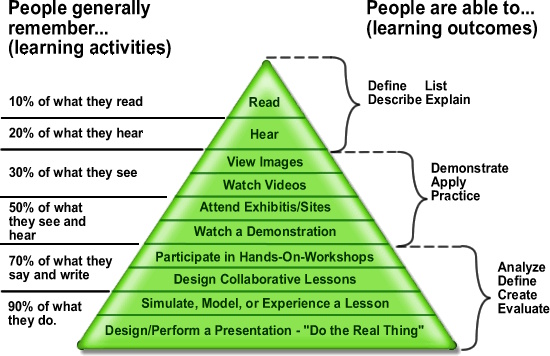
    Remember the old saying that you remember 10% of what you read, 20% of what you hear, 30% of what you see, and 80-90% of what you do? Well, a professionally-facilitated workshop should have the participants doing stuff for 80% of the time.

    By Jeffrey Anderson – http://www.edutechie.ws/2007/10/09/cone-of-experience-media/, CC BY-SA 3.0, https://commons.wikimedia.org/w/index.php?curid=37711912

    Workshops Are Not Lectures

      A workshop is designed for:

      • Exploration
      • Discussion
      • Co-creation
      • Problem solving
      • Skills practice

      If the facilitator dominates the airtime, the session quietly shifts from workshop to presentation. Participants become passive and energy drops. Ownership disappears. The moment the facilitator talks more than the group, the dynamic changes from engagement to consumption.

      The Wisdom Is In The Room

        One of the core principles of strong facilitation is this; the room is smarter than the facilitator.

        Workshop participants bring lived experience, context, expertise, and real-world challenges. When facilitators speak too much, they unintentionally override participant insights, short-circuit peer learning, and signal that the “right answer” comes from the front.

        Silence, on the other hand, invites contribution.

        Ownership Requires Voice

          People support what they help create. When participants generate ideas, debate trade-offs, articulate decisions, and shape solutions, they feel ownership. But if the facilitator fills every silence, answers every question, or summarises too quickly, participants lose the opportunity to think out loud and build shared understanding.

          Sometimes the most powerful facilitation move is simply asking; “What do you think?”

          And then waiting.

          Silence Creates Depth

            Many new facilitators early in their career rush to fill any quiet moments in the workshop. After all, silence can feel uncomfortable. But silence does important work:

            • It allows reflection
            • It encourages the quieter voices
            • It signals that thinking is valued
            • It slows reactive responses

            The Goal Is Capability, Not Dependency

              If participants leave saying that “the facilitator was great but I’m not sure what we decided” then the session was a failure. Effective facilitation builds the group’s capacity to:

              • Think clearly
              • Navigate disagreement
              • Make decisions
              • Solve problems independently
              • Commit to change

              What Workshop Facilitators Should Do Instead

                Speaking less does not mean doing less. Strong facilitators:

                • Ask sharp, well-timed questions
                • Clarify objectives
                • Manage time and flow
                • Surface patterns
                • Create psychological safety
                • Intervene when necessary
                • Are not afraid to raise difficult issues

                Essentially, a good facilitator will guide the process without dominating the content. However each facilitator will have their own specialist subject area and will be keen to impart some of their knowledge to the workshop participants. But it’s important to keep training points concise so that the real learning (conversations and shared experiences) has space.

              1. Snapshot: DISC Training and Assessment in Phuket April 15 2025

                Snapshot: DISC Training and Assessment in Phuket April 15 2025

                In my opinion, DISC is one of the most powerful tools available for team cohesion and leadership development. It’s also really approachable and user-friendly so groups very quickly get what it’s all about.

                My latest DISC workshop was conducted at Pullman Phuket Panwa Beach Resort for a group of 33 pax from the beauty/skin care industry. It was planned to be quite a long and intense afternoon with the first three hours dedicated to the DISC training and assessment and the final two hours focused on a fun, yet very challenging, indoor team building activity.

                We used an online DISC assessment for every group member to first identify their own DISC style and, through a facilitated group activity, understand more about their personal styles including strengths and weaknesses, motivators and stressors. With this understanding of themselves in place, we then looked at how each style can communicate more effectively with each of the other styles leading to improved collaboration. This is the key benefit of DISC. It’s not just a personality test. While based in personality, it is far more about one’s professional working style and how we can adapt our working styles to fit better in certain situations and avoid unnecessary and unproductive conflict.

                To end the DISC session I moderated a fireside chat between the group’s senior leaders in which each leader opened up about their DISC style, working style, professional preferences, and personal weaknesses. It was a valuable session as the group was able to better understand how to work with their leadership team as well as their colleagues.

                While I always try to make my team development and training workshops as fun as possible, there is serious work to be done of course. So it was nice to end the afternoon with two hours of team building before heading to dinner. Some really fun team challenges and games in the meeting room that raised the energy levels after an intense workshop and brought out everyone’s competitive spirit.

              2. Snapshot: 2-Day Team Building and DISC Workshop in Bangkok March 17-18 2025

                Snapshot: 2-Day Team Building and DISC Workshop in Bangkok March 17-18 2025

                This small group of 12 came to me from a well-respected software company and requested two days of team development training for their Asia regional marketing team. The event was to be held at their corporate offices in Bangkok and would welcome participants from Thailand, Singapore, Indonesia, Malaysia, and Philippines.

                The focus of this two-day event was to strengthen bonds between team members and develop further understanding of each others’ personalities and working styles in order to promote greater team productivity and reduced conflict.

                Day One. Team Building In Bangkok.

                It was a small group so we only had two teams in this mini version of our Amazing Race. It’s a slightly compressed version of our full race and is perfect for those occasions when time is limited. Of course, they had some serious meetings to attend to also! So, it was a 3-hour race around the streets of Bangkok.

                Starting from Le Meridien Bangkok, teams travelled across the city competing directly with one another in our rather amusing and highly engaging Amazing Race. This type of team building program is always so much fun in Bangkok. It’s such a busy place of course and there is always so much to see and do.

                The race ended at their selected restaurant for an evening of good food and celebration for team members who work closely together online but only get to see each other in person every year or two. These types of get-togethers and away days are crucial for team bonding.

                Day Two. DISC Workshop and Assessment.

                A DISC assessment and aligned experiential workshop is an incredibly powerful way to strengthen a team. An individual DISC assessment for each participant first identifies each team member’s personality and working style. We look at each profile’s strengths, weaknesses, motivators, and stressors. Understanding your own and your colleagues’ working styles is the first step towards greater collaboration.

                This particular team had a certain warmth about them and, during the break, deliveries came in of mango sticky rice, croissants, cookies, and a chocolate birthday cake. I have never seen so much food in a team development workshop before. There was so much food that there was an in-depth conversation about how best to pack the leftovers for transfer to various Asian countries the following day and whether customs had any rules about the cross-border shipment of mango sticky rice. We thought that there probably would be, especially in hand-luggage, but that it was worth a try.

                After everyone could eat no more, the workshop continued by looking at ways in which team members can adapt their behaviours in order to fit more closely with different styles. This is the whole point of DISC. How we can use our knowledge of others to adapt our own working styles to minimise unproductive conflict and improve collaboration.

                Once the four-hour workshop had finished and mangoes packed discretely in suitcases, it was time to head to the airport for several team members. Room for a croissant or two?

              3. Snapshot: Team Development and Leadership Training Phuket Oct 25 2024

                Snapshot: Team Development and Leadership Training Phuket Oct 25 2024

                This team development and leadership workshop on leading and facilitating teams, held at Pullman Phuket Arcadia Naithon Beach, was an intensive 5-hour session. The original plan was for a 4-hour session but when the group is fully engaged and the discussions are going well, it would be a shame to abruptly end things purely to stick to a schedule. So I allowed the conversations to continue for an extra hour and it was in that final hour that the group agreed upon some fantastic ideas for the future and committed to an implementation plan.

                Without commitment, those ideas would never leave the meeting room so it’s a crucial step towards change.

                Using DiSC profiling, workshop participants were able to identify and understand the differences between them with regard to personality and working styles. With better understanding of one another’s working styles, we can collaborate more effectively and reduce the chance of unproductive conflict.

                Taking it a step further, we analysed how an individual’s DiSC profile influences their leadership style and how, as leaders, we can modify our own behaviour depending on the situation and who we are dealing with. No leader is perfect and there is no best leadership style. We all have strengths and weaknesses as leaders. The intention in this leadership workshop was to adopt the strengths of each style in order to build more comprehensive leaders.

                One of the key learning outcomes was that the power of a team lies within its individual team members. There are differences in personality, culture, skill sets, ideas, and opinions. This diversity is what drives teams forward.

                My client was from the engineering and facilities management industry. A family-owned company that has been successful for over 80 years. There are not many companies that have been around for that long so they must be doing something right. I hope that the knowledge gained in this team leadership using DiSC workshop will be of benefit as the company continues to grow and thrive under the next generation of leadership.

              4. Snapshot: Team Development Workshop in Phuket May 8 2024

                Snapshot: Team Development Workshop in Phuket May 8 2024

                “How do we make a good team better?”

                This was the question from a recent client from the medical services industry. I was asked to work with the non-sales departments. This included Operations, HR, finance, IT, admin, regulatory affairs, and others. The focus was to be on improving teamwork and communication.

                Their team had been together for some time, knew each other pretty well, and were performing at an acceptable level. But the team and the company leadership all knew things could be better. This is a very common situation for teams to find themselves in.

                They had a full day available for this workshop and the event was held at Pullman Phuket Panwa Beach Resort.

                Building a Better Version of Your Team

                I was given full control over the workshop elements so I designed it to look at two major components; People and Processes.

                First, we looked at how we can improve team collaboration at an individual level. What can each team member do to foster better communication, greater empathy, and more accountability?

                Later we discussed ways in which their internal processes could be improved. How can we become more efficient and collaborative?

                Taking a team from good to great is one of my favorite workshops to facilitate. The learning outcomes from a workshop like this are real. Teams leave with a list of concrete action steps that they can implement as soon as they return to the office. In this case, we were able to delve deep into the underlying reasons behind some of their issues. They knew what the problem was but could not yet identify the cause. That’s the beauty of an externally-facilitated workshop. We use exercises and techniques that can surface hidden issues and ultimately help to discover the ‘why’ behind them.

                For me, there is nothing better in a workshop than guiding a team through a discovery process in which we find the root cause of a problem. Discovery is the first step. It highlights an underlying problem and gets it out in the open. From here, we can identify ways to deal with it. It’s an incredibly powerful tool.

                By the end of the day, the team and its leadership had a clear mandate. An action plan. A directive. Whatever we want to call it, they were in a position to make positive change to themselves and their team as a whole. I wish them all the best as they move towards a better version of their team, a goal that each and every team member shares.

              5. Snapshot: Conflict Management Training Workshop Bangkok Mar 5 2024

                Snapshot: Conflict Management Training Workshop Bangkok Mar 5 2024

                Dealing with Conflict At Work

                This half-day interactive workshop looked at conflict in the workplace. Every team has some degree of conflict. It’s inescapable. And, in fact, having a workplace in which nobody speaks up or shares their opinions is just as dangerous and ineffective as a high-conflict environment.

                What’s important is how teams and organisations deal with conflict. This workshop focuses on (a) identifying the causes of conflict within the organisation (b) identifying ways in which conflict can be minimised and (c) understanding how one can deal with conflict when it inevitably shows up. It’s a popular choice for a workshop because conflict at work is something that many people struggle with. Including myself in my previous corporate life.

                My client in Bangkok was from the financial services industry – a highly competitive industry with some strong characters and personalities. The intention was to help the organisation’s support staff to handle any conflict situations more effectively. Without care and attention, workplace conflict can lead to phyisiological problems such as stress and poor sleep. Resignation is often seen as the only way out.

                This particular team development workshop, held at Courtyard by Marriott Bangkok Sukhumvit 20, was a lovely group of 15 pax consisting of fourteen introverts and one lonely extrovert. However, through facilitation of several carefully-selected activities, everyone (including the introverts) had a chance to share their thoughts and we generated plenty of interesting conversations as to how conflict could be minimised within their organisation.

                Following the morning workshop, a fun team building program in the afternoon made the day both meaningful as well as memorable.

                As with any team development workshop of this nature, each individual is now responsible for bringing about change.

              6. Snapshot: 2-Day Team Workshop In Phuket Sep 22-23 2023

                Snapshot: 2-Day Team Workshop In Phuket Sep 22-23 2023

                Workshop Facilitation In Phuket

                I had received a brief from the Managing Director of the Singapore branch of an international construction company that their departments were not working together quite as well as they should be. While the team members knew each other pretty well, there was some tension developing between the different functions and he felt that collaboration was suffering.

                We agreed on a 2-day team building retreat at Four Points by Sheraton Phuket Patong Beach Resort with the afternoon of day one focused around a facilitated workshop and day two offering a fun team bonding experience.

                Collaboration Is Key

                “How can we improve team collaboration?” is one of the most common questions I am asked. That makes sense because a team without collaboration is like a car without wheels. It’s pointless.

                Over 4 hours, teams from sales, engineering, operations and finance (24 pax in total) participated in a range of group exercises and discussions designed to surface existing issues, communicate requirements to the other departments, and share ideas and action steps towards improved collaboration.

                As facilitator, it’s not my role to pass judgment or offer up my own ideas. What I did was create a safe environment in which participants felt comfortable to talk openly and then guided them through the learning process with exercises that followed a clear path from “where are we now?” to “where do we want to be?”.

                The participants took the opportunity to open up and share their thoughts and the levels of engagement were extremely high. After all, every participant wanted the same thing – to be able to do their jobs better.

                Day 2 was more about the team bonding but it was no less challenging. In fact, the challenge I had set was incredibly difficult and involved one shared goal for the entire team. With one hour to go though, I’ll admit that I was a little worried. I didn’t think they’d make it. But, somehow, in the last 15 minutes, everything fell into place and the end result was particularly satisfying.

                When they returned to the office the following Monday, they returned with a clear path forward.